On this page
Every quote you write is built on your hourly rate. Set it too low and you can be flat out all year and still go backwards.
Looking at what other shops charge is a good start. But their costs are not your costs. This guide gives you a rough market range, then shows you how to work out a rate from your own numbers. There is a calculator at the end of it.
What you need to know
- 2026 cost guides put workshop welding at roughly $85 to $165 an hour, with aluminium at the higher end.
- Break-even rate = yearly overheads plus wages, divided by the hours you can actually bill.
- Count your own wage and every on-cost: super is 12%, plus workers comp and leave.
- Billable hours are far fewer than paid hours. Quoting, ordering and cleaning are not billable.
- Add margin last, as a share of the price.
What do fabrication shops charge per hour?
There is no official list of shop rates. The best public figures come from cost guides. The Quote Yard published state guides in September 2026, and these are their workshop rates:
| Work (in the workshop) | NSW, per hour | VIC, per hour |
|---|---|---|
| General welding | $85 to $140 | $85 to $140 |
| Aluminium | $90 to $150 | $100 to $165 |
| Stainless | $100 to $160 | $110 to $180 |
| Mobile call-out fee (on top) | $120 to $250 | $90 to $220 |
Treat these as a rough range, not a rule. They come from a quote-matching site, not an industry survey. Aluminium sits higher because the welding is slower and the prep has to be cleaner. Site work costs more again, because of travel and set-up time.
For a feel of wages, Payscale puts the median base pay for a metal fabricator with welding skills at about $28 an hour, and about $35 for an experienced one. The gap between that and $85 or more an hour is what pays for the shed, the machines, the quiet weeks and the profit.
Why not just charge what other shops charge?
Because your rate has to cover your costs, not theirs. A one-person shop in a home shed and a five-person shop in a leased factory can quote the same job. Their costs per hour are nothing alike.
Use the market range as a check, after you have done your own sums. If your number comes out well above the range, look hard at your overheads and your billable hours. If it comes out well below, you may be leaving money on the table.
What counts as overheads?
Overheads are everything you pay to keep the doors open, whether you have work or not. Pull a year of numbers from your accounts and add up:
- Rent or the mortgage on the shed, and outgoings.
- Power, gas bottle rental and water.
- Insurance: public liability, tools, vehicles.
- Vehicles: finance, fuel, rego, servicing.
- Machine finance, repairs and servicing: welders, saws, the press.
- Software, phone, internet, the accountant and bank fees.
- Advertising and your website.
- Consumables you do not charge to jobs: discs, blades, wire, PPE.
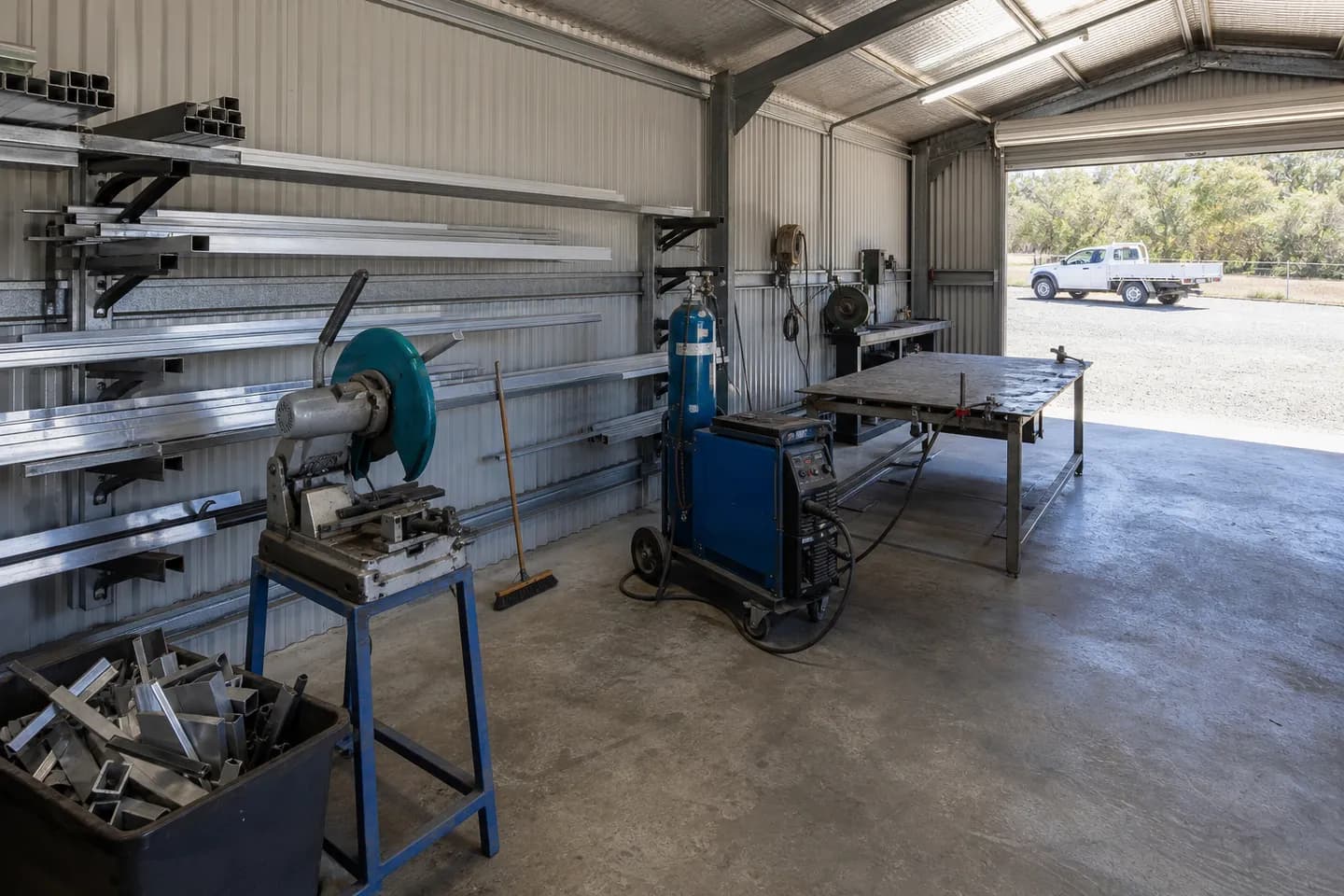
Do not count material or powder coat that you charge to a job. Those go on the quote as their own lines. The fabrication job quote guide shows where each one goes.
How do you cost wages and on-costs?
Take every wage in the shop for a year. Then add what each wage really costs you on top:
- Super. The super guarantee is 12% of ordinary earnings.
- Workers comp. The premium depends on your state and your industry. Your insurer will tell you.
- Leave. You pay four weeks of annual leave, personal leave and public holidays, but nobody is welding on those days. Add leave loading if your award has it.
- Payroll tax, if your total wages are over your state's threshold.
How many hours can you actually bill?
This is where most rates go wrong. A full-time worker is paid for about 1,976 hours a year (38 hours times 52 weeks). Take out the time nobody is on the tools:
| One full-time worker | Hours |
|---|---|
| Paid hours (38 x 52) | 1,976 |
| Less 4 weeks annual leave | -152 |
| Less about 10 public holidays | -76 |
| Less 10 days personal leave | -76 |
| At work | about 1,672 |
Not all of those hours are billable either. Quoting, ordering, cleaning up, fixing machines, waiting on material and redoing mistakes all happen at work but go on no invoice. Your own hours are often the least billable in the shop, because you do the quoting and the running around.
The honest way is to track it. Log a month of time sheets and count the hours that went onto jobs. Until you have that, be cautious. Using 1,200 to 1,300 billable hours per worker is a safer start than 1,976.
How do you work out your own shop rate?
Two sums. First the rate that covers your costs, then the rate you charge:
Break-even rate
(Yearly overheads + yearly wages with on-costs) divided by billable hours.
Charge rate
Break-even rate divided by (1 minus your margin). For a 20% margin, divide by 0.8.
Here is an example. A two-person shop has $90,000 of overheads and $165,000 of wages with on-costs, the owner included. They bill 2,500 hours between them. Break-even is $255,000 divided by 2,500, which is $102 an hour. With a 20% margin, the charge rate is $127.50 an hour. Put your own numbers in below.
Shop rate calculator
Type your own yearly numbers. All figures in AUD.
Rent, power, gas, insurance, vehicles, machine finance, software, accountant.
Everyone, you included. Add super, workers comp and leave.
Hours you can charge to a job, for everyone on the tools.
Profit as a share of the price, not a markup on cost.
Break-even rate
$102 /hr
Covers costs. Nothing left over.
Charge rate
$128 /hr
$26 profit in every hour you bill.
A big part of the non-billable time in a small shop is paperwork: quotes, drawings, changes. Every hour you cut from that is an hour you can put on a job.
How much margin should you add?
Margin is the profit share of the price. It is not a markup on cost: a 20% margin means a 25% markup. The margin pays for growth, new machines and the slow months. Without it, your rate only keeps you where you are.
Pick a margin, run the numbers, and check the result against the market range at the top of this page. If you land in the range, good. If you land well above it, cut overheads or win back billable hours before you lower the margin. Then use the rate the same way on every job, like the sliding gate quote guide does.
Review your rate every year, and any time you take on a new person, a new lease or a big machine.
Common questions
What is a good hourly rate for a welder in Australia?
For a shop charging customers, 2026 cost guides show about $85 to $140 an hour for general workshop welding and up to about $165 for aluminium. Mobile welders add a call-out fee on top.
Should aluminium work cost more per hour?
Most shops charge more for it. Aluminium needs cleaner prep, TIG or a spool gun, and more care with heat, so the same job takes longer. The cost guides show aluminium rates above general welding rates.
Do I charge the same rate for site work?
Many shops charge more on site, or add a call-out fee, to cover travel, loading and set-up time. Either way, price the travel. It is time you cannot spend in the shop.
Is a shop rate the same as a labour rate?
A labour rate is often just the wage. A shop rate is everything: wages, on-costs, overheads and margin, spread over the hours you bill. Quote with the shop rate.
How often should I raise my shop rate?
Run the numbers once a year and whenever your costs jump: a wage rise, a new lease, a new machine or a new worker. If the break-even rate moved, the charge rate has to move too.
Should my own time be in the shop rate?
Yes. Put a fair wage for yourself in the wages figure. If you leave it out, your profit is really just your unpaid wage.
Written by Harry Tolley
Harry builds CAD60 with his dad, who has run a fabrication business for 20 years. We write these guides from what goes wrong in a real shop.