On this page
- What is a gate lock box and when do you need one?
- Should the lock box be welded in or bolted on?
- What backset and lock should you buy?
- How do you fit a welded lock box to an aluminium gate?
- What is a lock surround plate and do you need one?
- How do you keep the latch stile strong?
- Where does the striker go, and how big should the latch gap be?
- What does CAD60 draw for the lock box?
- Watch it done in CAD60
- Common questions
A gate frame is made of tube, and a lock body does not fit inside a 50 mm stile. A lock box fixes that. It is a small metal housing on the latch side that holds the lock, so you can fit a normal lever or deadbolt to a metal gate.
It looks like a simple job. Most of the problems come from doing it in the wrong order: welding the box before you have the lock, cutting too much out of the stile, or finding the striker does not line up once the gate is hung. This guide goes through it in the right order, for aluminium gates.
What you need to know
- Buy the lock first. Size the box to the lock body and its backset, not the other way round.
- Set the lock centre at about 1000 to 1100 mm from the ground.
- On an aluminium gate, weld an aluminium box, or use a bolt-on box.
- Cut the latch stile only as much as the latch needs. The welded box helps stiffen what is left.
- Keep the latch gap smaller than the latch throw, and line the striker up on the latch post.
What is a gate lock box and when do you need one?
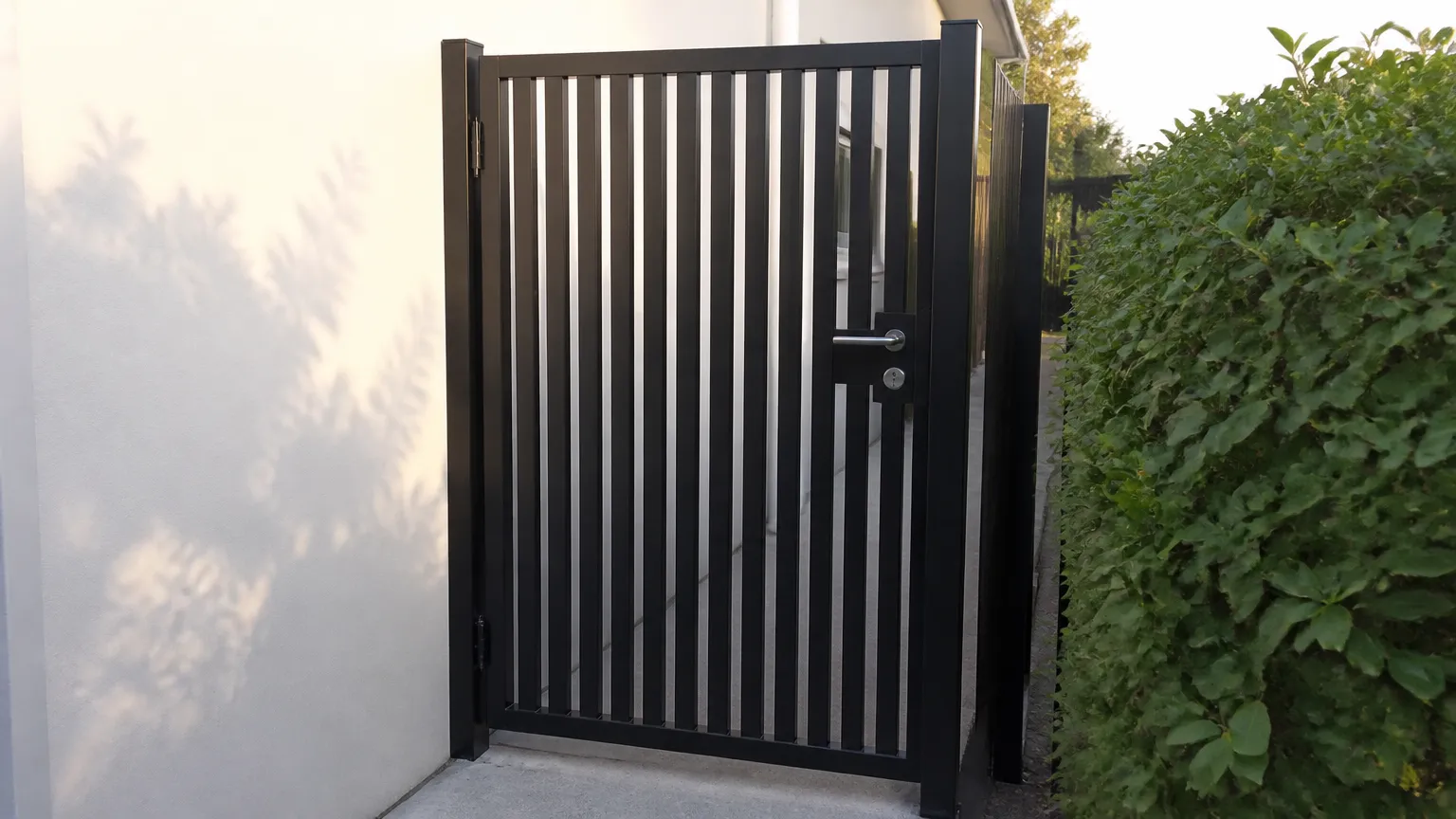
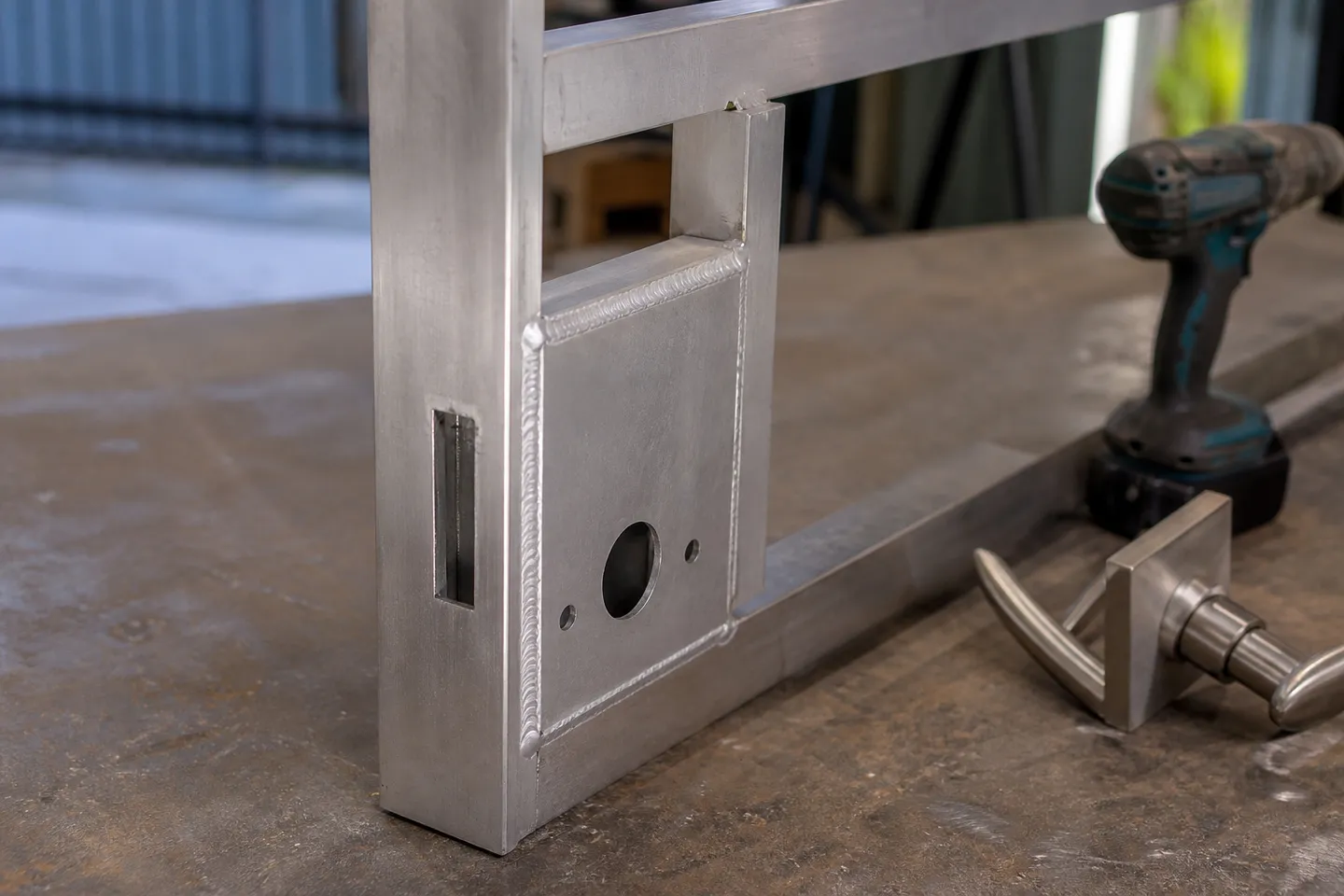
A lock box is a box, usually around 100 mm square and as deep as the frame, fixed to the latch stile. The lock body sits inside it. The handles or key cylinder go through holes in its faces, and the latch tongue comes out through the stile to the post.
You need one when the lock body is deeper or taller than the stile can take. That covers most lever and ball handle locks on tube frames. You do not need one for every lock:
| Lock | Lock box? | Notes |
|---|---|---|
| Lever or ball handle lock | Usually yes | The body is too big for a tube stile |
| Mortice lock | No | Cut into a deep stile, often by CNC |
| Frame-mounted latch (Lokklatch style) | No | Fixes to the frame and post with a drilled hole or two |
| Gravity latch or drop latch | No | Surface fixed, no key |
Should the lock box be welded in or bolted on?
Welded in is the neat, strong option for a new gate. The box becomes part of the frame and gets powder coated with it. On an aluminium gate, the box has to be aluminium too, because you can only weld like metal to like metal. A clean aluminium weld all round the box looks factory made.
Bolted on suits a gate that is already finished or already hanging. A bolt-on box clamps or screws to the stile, so there is no welding and no fresh powder coat. It sits proud of the frame and looks less tidy, but it is quick.
Either way, buy the lock first. Lock boxes are made to suit a backset, and the lock decides the backset.
What backset and lock should you buy?
The backset is the distance from the edge of the lock, on the latch side, to the centre of the key cylinder or handle spindle. It sets where the holes go in the box and how wide the box needs to be.
60 mm is a very common backset for lever sets and deadbolts. Some lever sets use 70 mm. Australian lock box makers sell boxes to suit each one, so check the lock's spec sheet before you order or build the box.
When you pick the lock, think about:
- Lever or ball handle. A lever is easier to open with full hands. A ball handle is cheaper and more compact.
- Keyed both sides or one side. A gate onto the street usually needs a key outside and a handle or key inside.
- Outdoor rating. Lever sets from Lockwood or Gainsborough style ranges are built for doors. Pick one sold for outdoor use, because a gate lock lives in the rain.
- Electric strike. If the gate will be opened by remote or keypad, plan the strike and the cable path through the latch post now.
How do you fit a welded lock box to an aluminium gate?
Pick the height
Set the centre of the box at about 1000 to 1100 mm from the ground. Check it does not land on a mid rail. If it does, move it, or cut the rail and weld it to the top and bottom of the box.
Mark the latch stile
Mark the box position and the latch tongue hole on the stile. The tongue has to pass through the stile and line up with the striker on the post.
Cut the latch opening
Cut a slot through the stile just big enough for the latch tongue and forend. Do not cut more than you need.
Drill the box
Drill the cylinder and spindle holes through both faces of the box at the backset, plus the fixing holes. Drill before welding while you can still clamp it flat.
Tack, check and weld
Set the box flush with the frame faces and hard against the stile. Tack it, test fit the lock, then weld it out. Short runs, swapping sides, keep the heat from pulling the stile.
Coat first, lock last
Powder coat the gate, then fit the lock. Clean any powder out of the holes and the latch slot first.
What is a lock surround plate and do you need one?
On a battened gate, the battens leave gaps around the lock. Someone outside can reach through to the inside handle, and the handle furniture has nothing flat to sit on. A lock surround plate fixes both.
It is a solid plate, often 3 mm thick and a bit bigger than the lock box, welded flush with the front face of the frame around the lock. Battens that cross it are cut short and welded to the plate. The latch stile is recessed so the plate sits flush. The batten ends can be square cut or tapered at 45 degrees down to the plate.
Keep the plate shorter than the batten run, so the battens still have frame to fix to above and below it.
How do you keep the latch stile strong?
Every hole in the latch stile takes metal away. The lock box puts some back, but only if it is welded on properly.
- Cut only the slot the latch needs. Round off its corners, because square corners are where cracks start.
- Weld the box to the stile along its full height, on both faces.
- If a mid rail runs through the lock height, weld the cut ends of the rail to the box, so the rail still ties the stiles together.
- On a wide or heavy leaf, use a deeper latch stile, such as 65x35 instead of 50x25. The pedestrian gate sizes guide covers common frame sections.
Where does the striker go, and how big should the latch gap be?
The striker (the keep) goes on the latch post, lined up with the latch tongue. On a square post you cut a slot for the tongue and screw the striker over it. An electric strike sits in the post the same way, with its cable run down inside the post.
The gap between the gate and the latch post is usually tighter than at the hinge side. Around 8 mm at the latch and 15 mm at the hinge are common starting points. The rule that matters: the latch throw has to reach well past the gap, or the tongue barely catches. Check the throw on the lock's spec sheet.
A catch plate across the gap helps. Welded to the latch stile or the latch post, it stops the gate swinging past closed and gives the latch a solid face to close against. Keep it clear of the lock box. Hang the gate on good hinges too, because a gate that drops pulls the tongue off the striker. See gate hinge types.
What does CAD60 draw for the lock box?
On the battened pedestrian gate you pick the lock type: lever handle, ball handle, mortice, Lokklatch, other (you type the brand and model) or none. The hinge side sets the latch side, so the lock goes on the opposite stile.
- Lever and ball handle locks can have a welded lock box. You set its width, height and centre height from the ground (100x100 mm at 1100 mm to start). The battens pass in front of it.
- With a lock box you can add a lock surround plate. The battens are cut short onto it, the latch stile is recessed for it, and it gets its own zoomed Lock Detail page.
- The lock note names the lock, the box size and the hinge side, and an electric strike if you add one.
- The hinge and latch gaps you set come off the opening to size the leaf. An optional catch plate is drawn on the latch stile or the latch post.
For the rest of the build, see how to build an aluminium pedestrian gate.
Watch it done in CAD60
Common questions
What height should a gate lock be?
Most gate locks sit with their centre about 1000 to 1100 mm above the ground. That is a comfortable handle height for most people and usually clears the mid rails.
What is a backset on a gate lock?
It is the distance from the latch edge of the lock to the centre of the key cylinder or handle spindle. 60 mm is common, and some lever sets use 70 mm. The lock box must suit it.
Can you fit a door lever set to a metal gate?
Yes, inside a lock box sized for it. Choose one sold for outdoor use, because a gate lock sits in the weather. Check the backset and the door thickness range it suits.
Can you weld a lock box onto an aluminium gate?
Yes, if the lock box is aluminium. You cannot weld a box made of a different metal to an aluminium frame. For a finished gate, a bolt-on box avoids welding and recoating.
Why won't my gate lock line up with the striker?
Usually the gate has dropped or the latch gap has grown. Check the hinges and hinge post first. If the gate is sound, move or re-slot the striker on the latch post.
Do you need a lock box for a Lokklatch?
No. A Lokklatch style latch is made to fix to the frame and post with a drilled hole or two, so it needs no lock box.
Written by Harry Tolley
Harry builds CAD60 with his dad, who has run a fabrication business for 20 years. We write these guides from what goes wrong in a real shop.