On this page
- What do you need to build an aluminium gate?
- How wide should the gate be for the opening?
- What size tube should the frame be?
- How do you weld the frame without it twisting?
- How far apart should the battens be?
- Which hinges and latch should you use?
- How do you set the gate posts?
- How do you finish an aluminium gate?
- Watch it done in CAD60
- Common questions
A pedestrian gate is the best first gate to build. It is small enough to handle on your own, but it has every part a big gate has: a frame, infill, hinges, a latch and posts. Get one right and the rest are just bigger.
This guide walks through a battened aluminium side gate from tape measure to powder coat. The numbers are for a common 1,000 mm opening and a 1,800 mm tall leaf. Swap in your own sizes as you go.
What you need to know
- Measure the clear opening between the posts, then take off the hinge and latch gaps to get the leaf width.
- A 50x50x3 SHS frame with mitred corners suits most aluminium side gates.
- Work out the batten count from the leaf width so every gap comes out the same.
- Tack all four corners and check both diagonals before you weld anything out.
- Do every weld and every hole before the gate goes to the powder coater.
What do you need to build an aluminium gate?
You need a way to cut aluminium cleanly, a way to weld it and a flat surface to build on. Here is the usual list:
- A drop saw with a blade made for aluminium (non-ferrous).
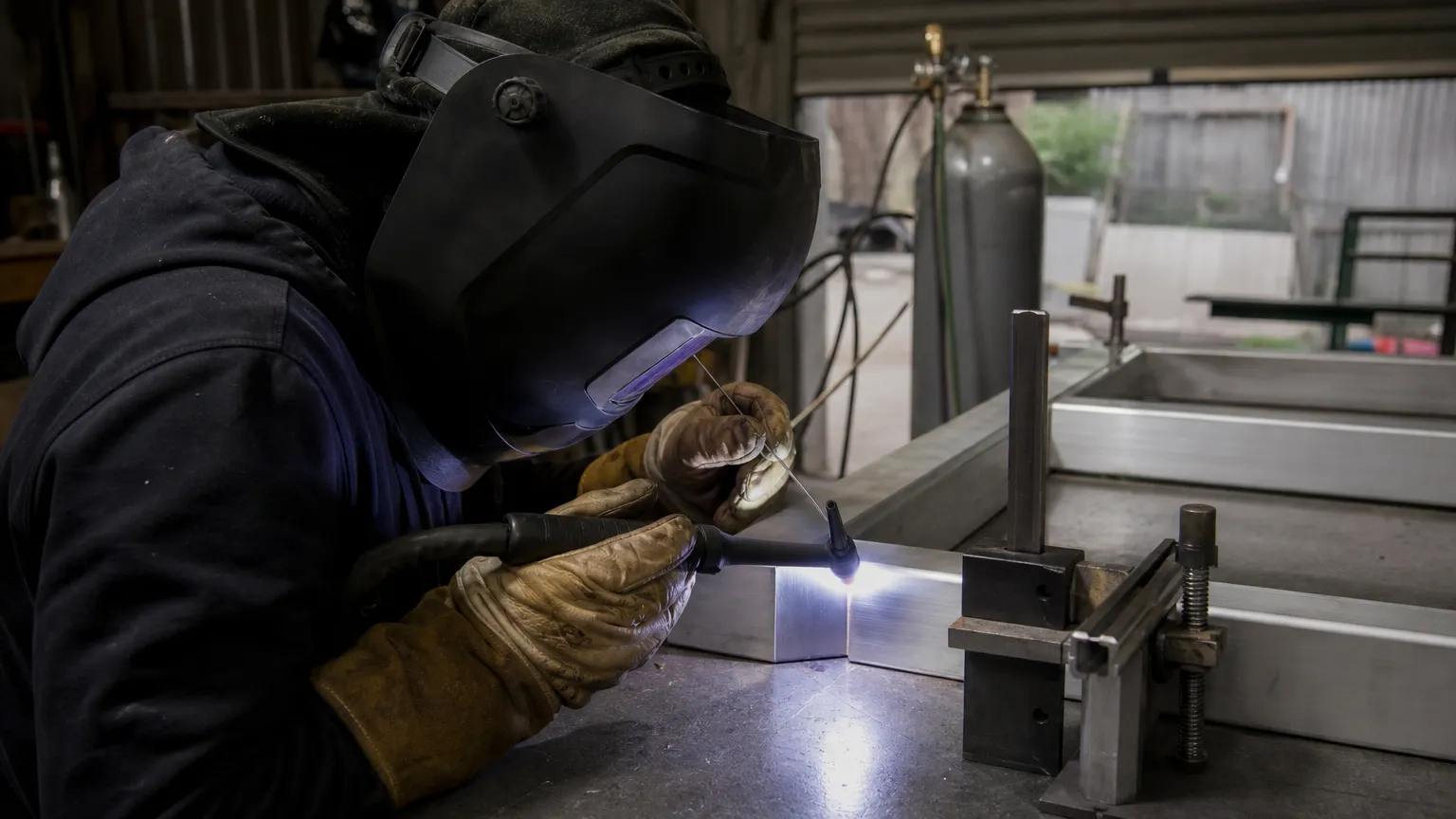
- An AC TIG welder, or a MIG with a spool gun.
- A stainless wire brush that only ever touches aluminium.
- Clamps, a large square, a tape and a flat bench or a pair of level trestles.
- A drill and a tek screw gun if you screw the battens on.
For a 1,000 mm opening, the material list looks like this:
| Part | Section | Qty |
|---|---|---|
| Frame stiles | 50x50x3 SHS, 1,800 mm | 2 |
| Frame rails | 50x50x3 SHS, 977 mm | 2 |
| Battens | 65x16 aluminium, 1,800 mm | 11 |
| Posts | 65x65 or 75x75 SHS | 2 |
| Hinges | Weld-on or bolt-on, rated for the leaf | 1 pair |
| Latch or lock | To suit the job | 1 |
The sections below explain where each of those numbers comes from.
How wide should the gate be for the opening?
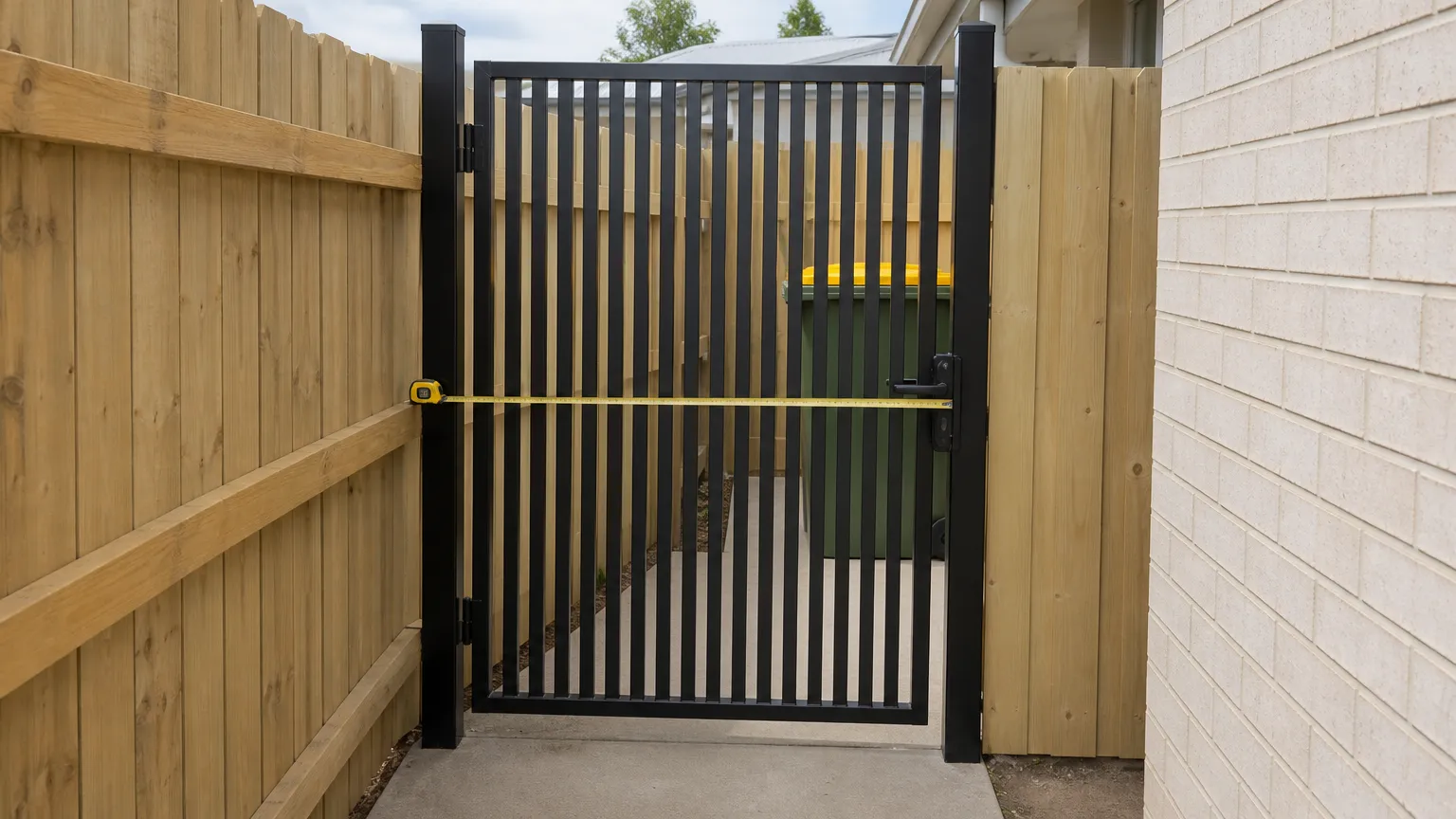
Start with the clear opening: the distance between the faces of the two posts. Then take off a gap on each side. The hinge side needs room for the hinges to turn. The latch side needs room for the latch and a little slack so the gate does not bind.
A hinge gap of about 15 mm and a latch gap of about 8 mm are good starting points. Those are the defaults CAD60 uses. Your hinge and latch may want something else, so check the maker's fitting sheet before you cut.
| Measurement | Example |
|---|---|
| Clear opening between posts | 1,000 mm |
| Hinge side gap | 15 mm |
| Latch side gap | 8 mm |
| Leaf width | 1,000 minus 15 minus 8 = 977 mm |
| Gap under the gate | 50 mm |
The gap under the gate depends on the ground. Leave more if the path rises across the swing, or the gate will scrape. For common widths and heights, see standard pedestrian gate sizes, and how to measure up a gate job for the site visit.
What size tube should the frame be?
For a side gate up to about 1,200 mm wide, a 50x50x3 SHS frame is a safe choice in aluminium. A 40x40x3 frame works on small, light gates. Wider or taller leaves want a deeper section on the rails, such as a 75x50 RHS.
Aluminium flexes more than heavier metals, so go deeper rather than thicker when you need more stiffness. The RHS vs SHS guide explains why.
A plain rectangle in one section suits mitred corners. They look clean once the gate is powder coated and give a bit more weld length than a butt joint. Add a mid rail if the battens are long and you want something to fix them to halfway up.
How do you weld the frame without it twisting?
Cut the four frame pieces
Cut the two stiles and two rails at 45 degrees. Measure the long point of each mitre. Matching pieces must be the same length to the millimetre.
Clean every joint
Brush the oxide off the joint faces and wipe them with a clean solvent. Dirty aluminium gives porous, weak welds.
Clamp and tack the corners
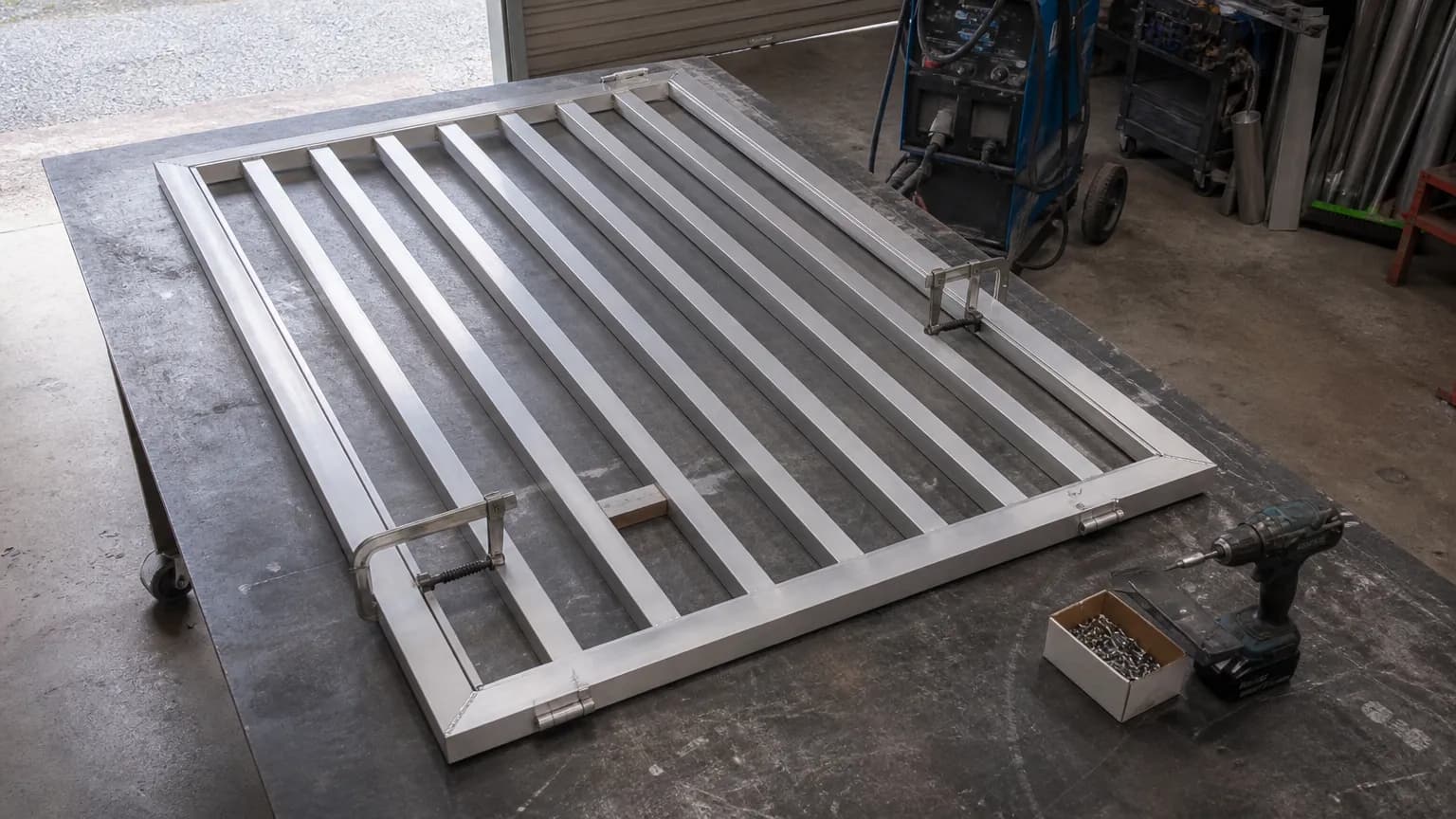
Lay the frame on a flat bench, clamp it and put a small tack on each corner.
Check both diagonals
Measure corner to corner both ways. Tap the frame until the two numbers match. Do not weld out until they do.
Weld in a balanced order
Weld one corner, then the corner opposite it, then the other two. Let it cool between runs and check the diagonals again at the end.
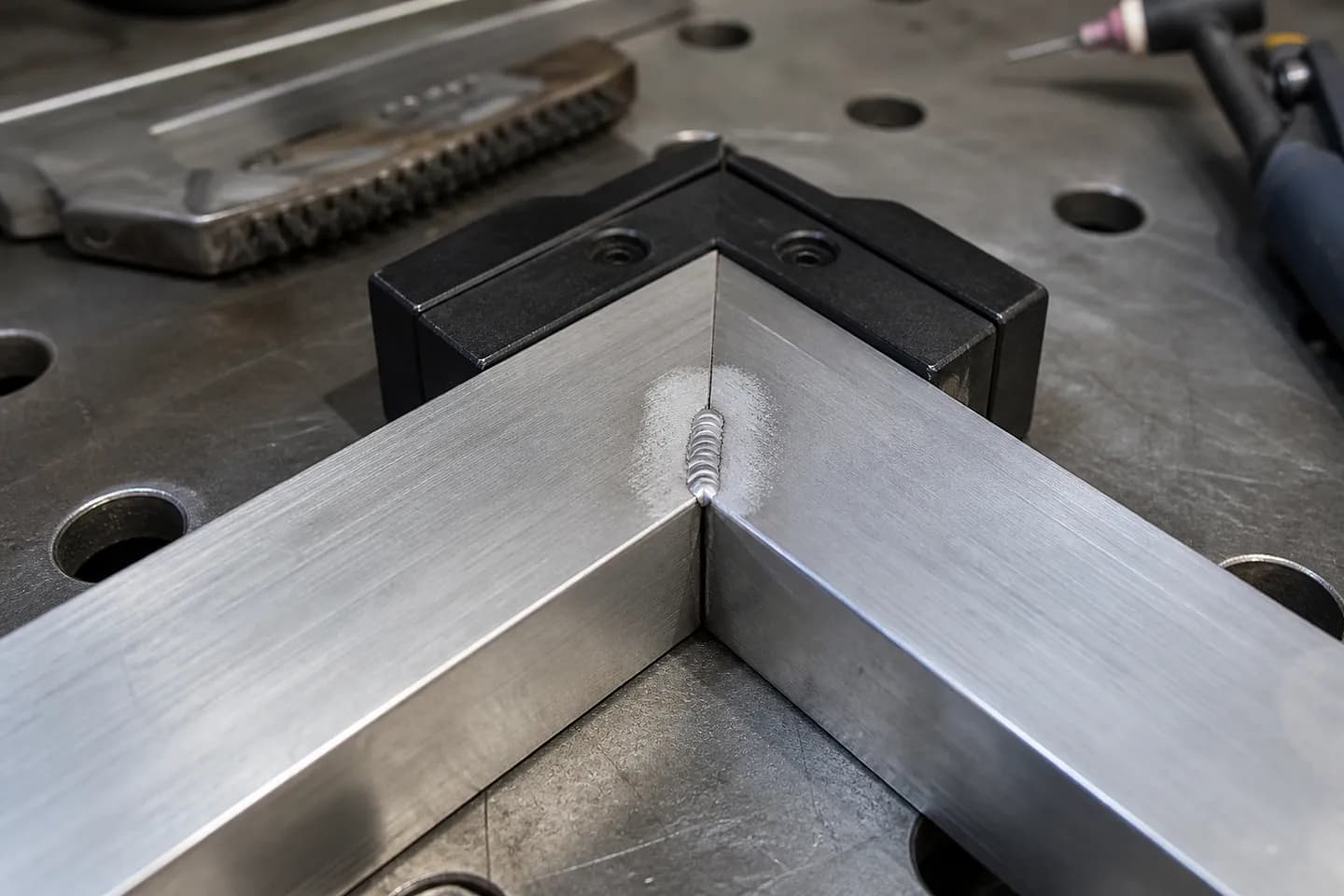
More on this in how to weld an aluminium gate and how to stop a gate frame warping.
How far apart should the battens be?
Pick a target gap, then work out how many battens fit so the gaps come out even. On this gate the battens sit on the front of the frame across the full 977 mm, with the same gap at each end.
The sum is:
- Battens = (leaf width minus gap) ÷ (batten width plus gap). Round to the nearest whole batten.
- Real gap = (leaf width minus all the battens) ÷ (battens plus 1).
With 65 mm battens and a 20 mm target: (977 minus 20) ÷ 85 = 11.3, so 11 battens. They take up 715 mm, which leaves 262 mm. Split across 12 gaps, that is 21.8 mm each. Close enough to 20 mm that nobody will tell, and every gap matches.
The same maths works for any infill. The slat screen gap spacing guide has a full table.
Fix the battens with tek screws or rivets from the back of the frame, or weld them. Screws from behind hide the heads and let you swap a damaged batten later. Use a spacer block cut to the gap so you do not measure every one.
Which hinges and latch should you use?
A light aluminium side gate does not need heavy hardware, but it does need hardware rated for its weight. The common choices:
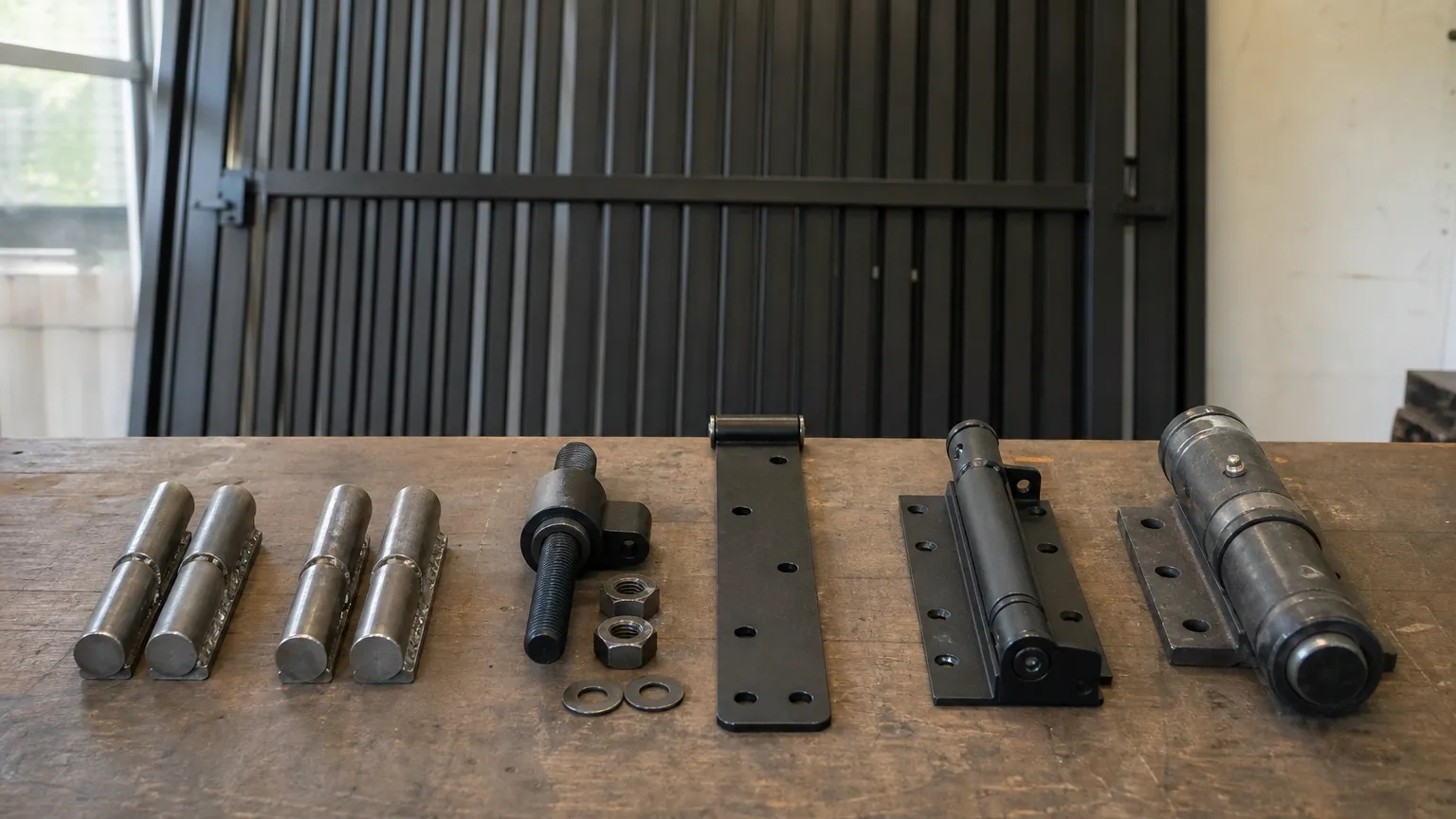
- Weld-on hinges: cheap and strong, but no adjustment once they are on.
- Bolt-on adjustable hinges: you can lift the latch end later with a spanner.
- Self-closing hinges: from makers like D&D Technologies or Locinox, when the gate must swing shut on its own.
On the latch side, a gravity latch, a magna latch or a lever handle lock all work. A lever lock usually sits in a lockbox welded into the frame. See how to fit a lock box and gate hinge types for the detail.
How do you set the gate posts?
Most side gates hang on 65x65 or 75x75 posts. Set them in concrete about 600 mm deep in a 300 mm hole, or use a footplate post bolted to a slab with dynabolts or chemical anchors.
Set the posts at the clear opening you measured, plumb on two faces, with a string line across the top. Let the concrete cure before you hang the gate. A post that moves while it is green shows up as a dropped latch end later. For sizing, see gate post size.
How do you finish an aluminium gate?
Powder coat is the usual finish. Do every weld, every hole and every bracket first. Anything you drill after coating leaves bare metal and a chipped edge.
Take off any sharp edges and burrs, then send the gate, posts and loose parts together so the colours match. Dark greys and black are the popular picks, often matched to the house's Colorbond fence or roof. Mask hinge pins and threads, or ask the coater to.
Watch it done in CAD60
Common questions
Can you build an aluminium gate without a welder?
Yes. Some suppliers sell bolt-together frames with corner joiners, and battens can be riveted or screwed on. A welded frame is stiffer and lasts longer, so most shops still weld the frame.
How much gap should a gate have on the hinge side?
About 10 to 15 mm is common, enough for the hinge knuckles to turn. Self-closing and adjustable hinges each have their own number, so read the maker's fitting sheet first.
What batten size is best for a side gate?
65x16 aluminium battens are the common pick. They look right on a 1,000 mm gate and are stiff enough over 1,800 mm. Wider battens like 90x16 give a bolder look and fewer gaps.
Should the battens go on the front or inside the frame?
Either. On the front of the frame they hide the frame from the street and are quicker to fit. Inside the frame they sit flush and look neater from both sides, but every batten must be cut to fit.
Do you powder coat before or after welding?
After. Welding burns powder coat off and leaves bare, discoloured metal. Finish every weld, hole and bracket, then send the gate to the coater as one finished piece.
Do I need a brace on an aluminium side gate?
Usually not on a 1,000 mm leaf with a 50x50 frame and battens screwed to it. Past about 1,200 mm wide, or with a light frame, add a mid rail or a diagonal brace.
Written by Harry Tolley
Harry builds CAD60 with his dad, who has run a fabrication business for 20 years. We write these guides from what goes wrong in a real shop.