On this page
- Why does a gate frame warp when you weld it?
- What kinds of warp show up on a gate frame?
- How should you clamp the frame?
- What tack pattern stops the frame moving?
- What weld order keeps the frame straight?
- Do pre-setting and weld size make a difference?
- How do you fix a frame that has already warped?
- Common questions
You cut everything right and clamped it square, then welded it, and it came off the table racked or twisted. Every frame moves when you weld it. The trick is to make the moves cancel each other out.
This guide covers why frames warp, how to clamp and tack, the weld order that keeps a gate flat, and what to do with one that has already moved. It is written for aluminium gate frames, which move more than most.
What you need to know
- Welds shrink as they cool and pull the joint toward them. Uneven welding means uneven pull.
- Clamp the frame to a flat table and leave it clamped until it is cool.
- Tack all four corners on more than one face before any full weld, then check the diagonals.
- Weld short runs on opposite corners in turn, then flip and do the back.
- Do not heat straighten aluminium. Cold straighten it, or cut a corner and re-weld it.
Why does a gate frame warp when you weld it?
Heat makes metal grow. When a weld cools it shrinks, and because it is fused to the tube it drags the metal around it in with it. One weld pulls a little. Lots of welds on the same side pull a lot.
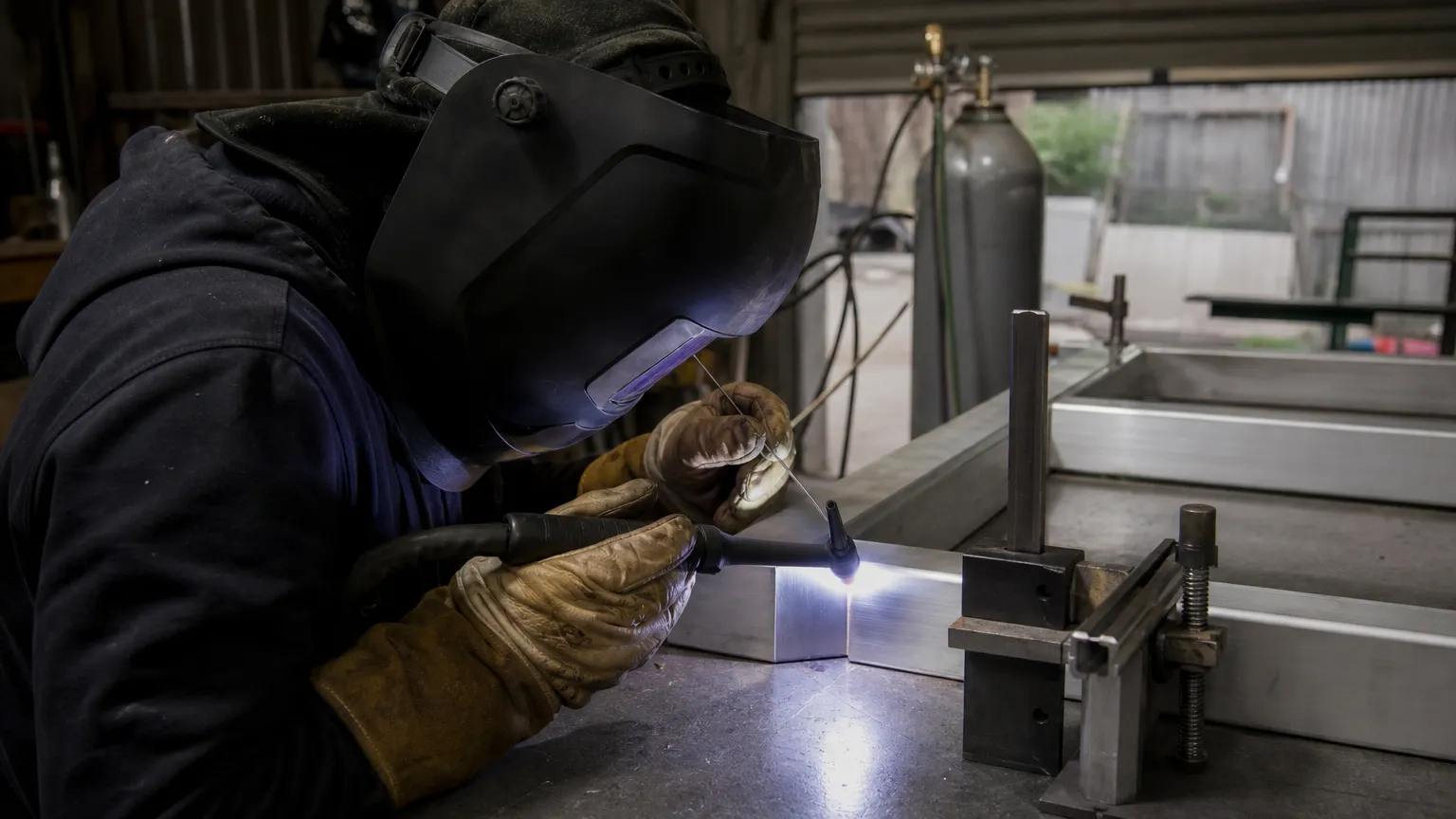
Aluminium makes this worse. It grows about 2.3 mm per metre for every 100°C, so a 1.8 m stile gets longer near a hot weld. It also spreads heat a long way along the tube, so more of the frame grows and then shrinks. And it needs plenty of amps, which means more heat going in.
Big welds make it worse again. The more weld metal you put in a joint, the more it shrinks.
What kinds of warp show up on a gate frame?
Each one has a different cause, so it helps to know which you have.
| What you see | How to check | Usual cause |
|---|---|---|
| Racked (out of square) | Diagonals are different lengths | Two corners on the same side welded first |
| Twisted | Frame rocks on a flat table, one corner lifts | All the welds on one face, or a table that is not flat |
| Bowed stile or rail | Straight edge shows a gap in the middle | A long weld or lots of infill welds on one side |
| Corner pulled in | Framing square shows a gap at one corner | A big weld on the inside of the corner only |
How should you clamp the frame?
Clamping holds the frame while the welds cool and set. It will not stop shrinkage, but it stops the frame moving while the metal is soft.
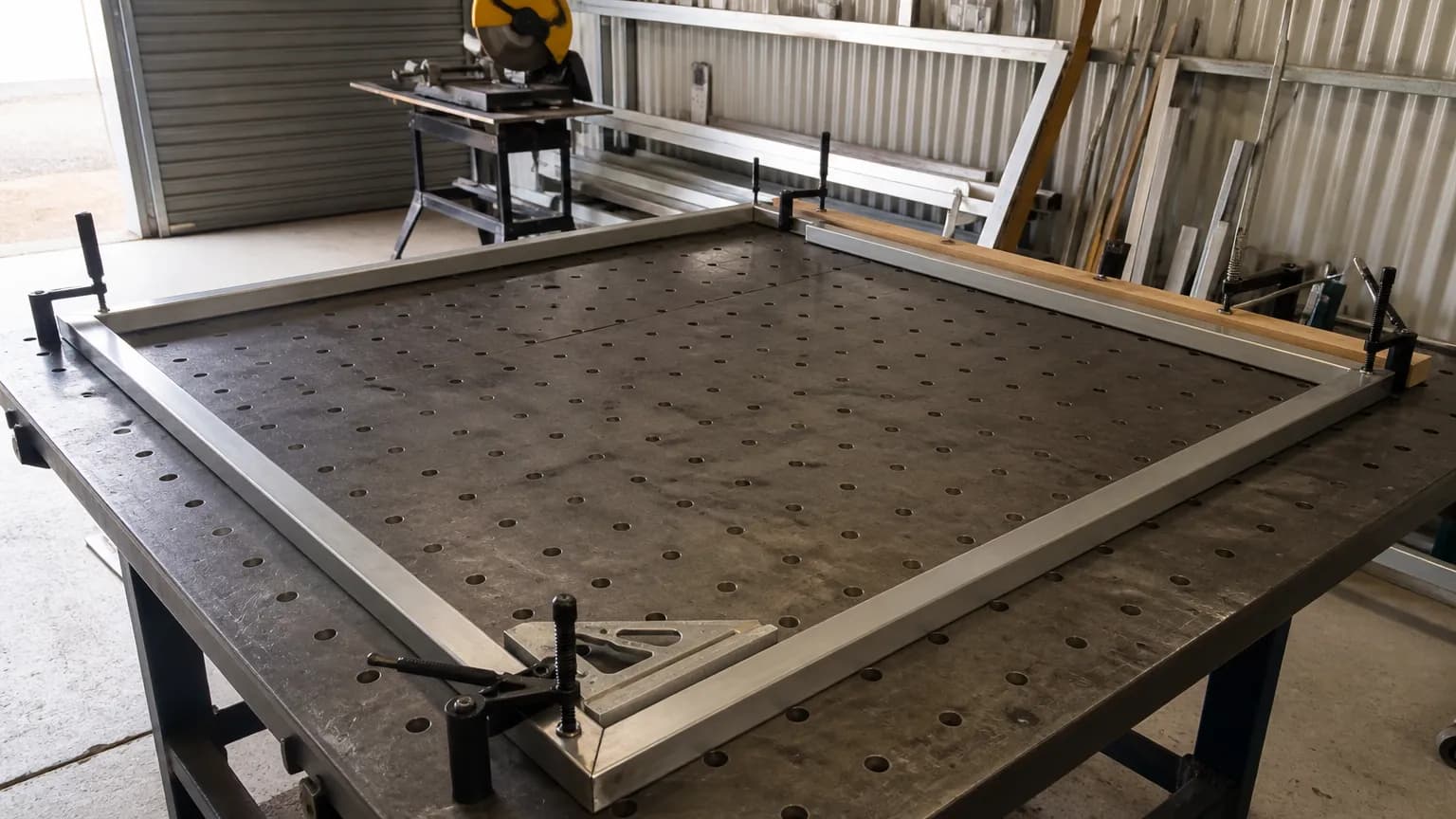
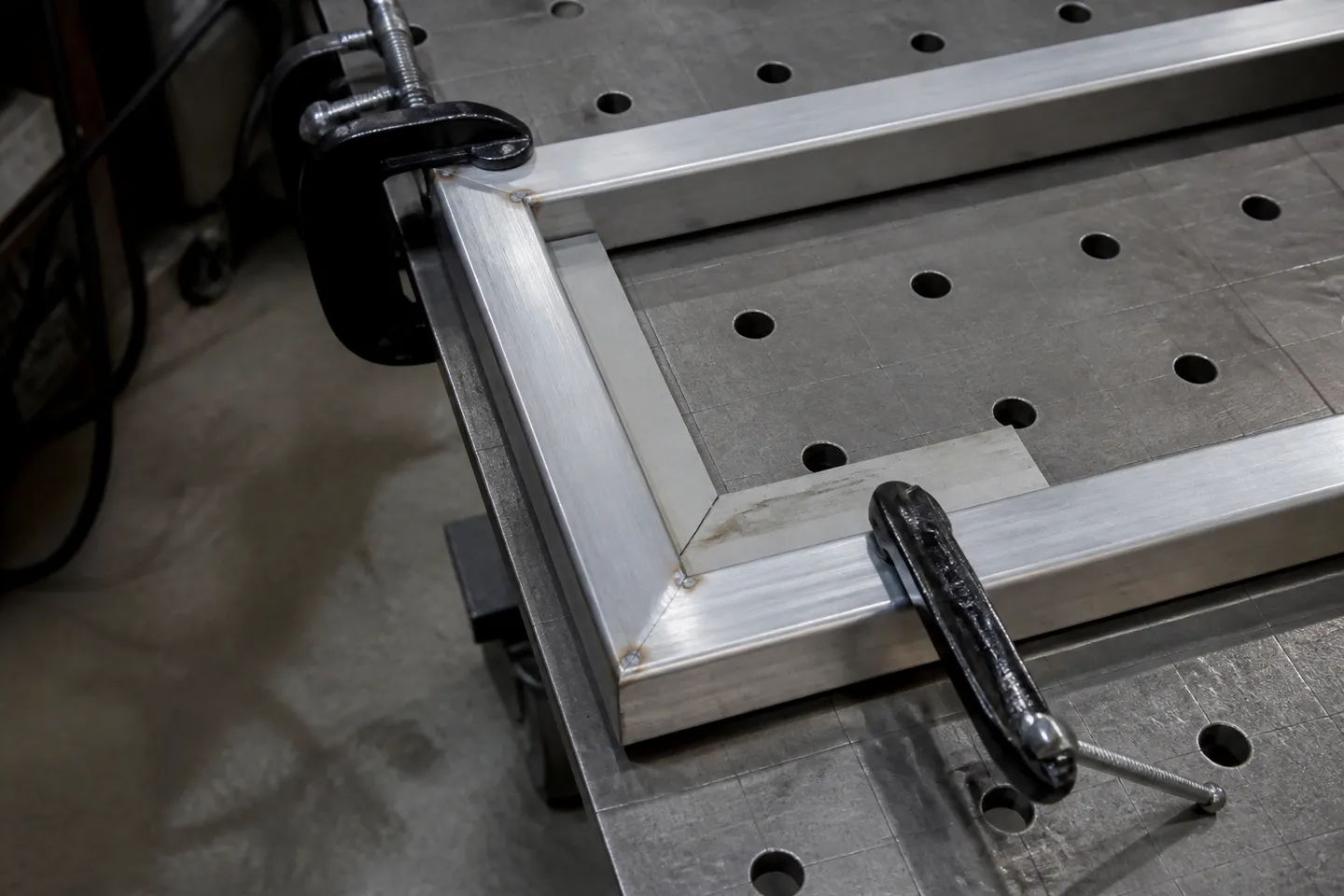
- Check the table is flat. Run a long straight edge across it both ways. A twisted table makes a twisted gate.
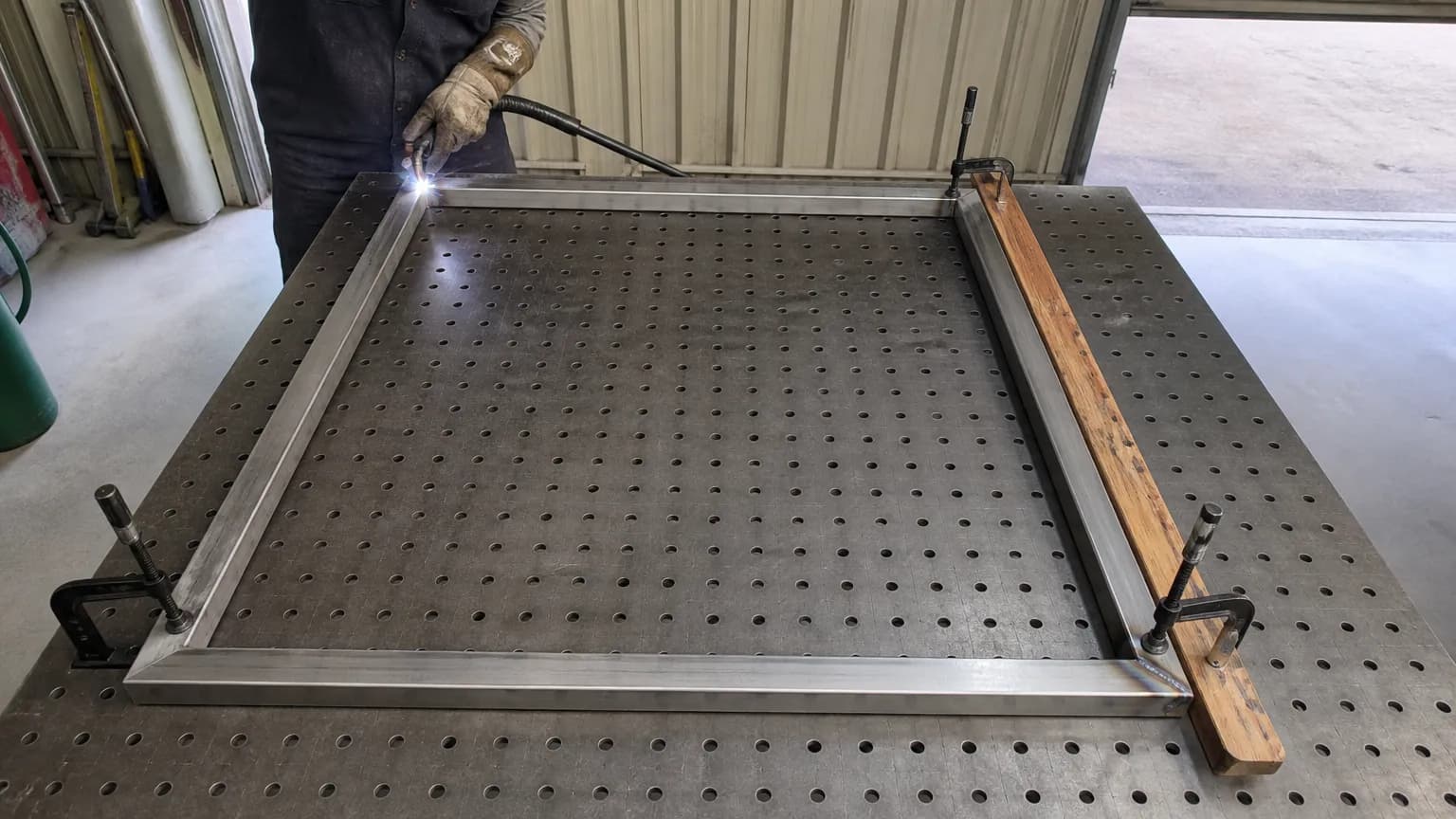
- Clamp a stop block along one side and push the hinge stile up against it.
- Set every corner with a framing square and clamp each one to the table.
- Measure both diagonals. Tap the frame until they match, then clamp tighter.
Leave the clamps on until the corners are cool enough to rest your hand on. Let go while it is hot and the frame springs to wherever the welds want it.
What tack pattern stops the frame moving?
Tacks lock the frame before the big heat goes in. Do them in this order:
One tack per corner, opposite corners in turn
Top left, then bottom right, then top right, then bottom left. Keep each tack weld small and hot enough to fuse.
Check the diagonals
If they have moved, break a tack, adjust and tack again. This is the cheap time to fix it.
Tack the other faces
Tack the back and outside faces of each corner, in the same opposite-corner order.
Tack the infill and braces
Tack every batten, rail or brace in place before you full weld any of them.
What weld order keeps the frame straight?
The idea is balance. Every pull on one side gets matched by a pull on the other side before it has time to set.
- Opposite corners. Weld one face of a corner, then the same face of the corner diagonally across. Then the other two.
- Both faces. Flip the frame and weld the back in the same order. All the weld on one face is what twists a gate.
- Short runs. Do not weld a whole corner in one go. Weld part of it, move on, and come back once it has cooled a little.
- Back-step on long joints. Work along the joint from left to right, but lay each short bead from right to left. Each new bead finishes against the one before it, which spreads the heat.
On infill, stitch from the middle out and swap sides as you go. A stitch weld puts in far less heat than a continuous weld.
Do pre-setting and weld size make a difference?
Yes. Pre-setting means setting a part slightly out so the weld pulls it true. If you know a stile always bows toward the infill side by 3 mm, clamp it with 3 mm of bow the other way. It takes a few frames to learn how much, so write down what each frame does.
Weld size matters as much. A fillet weld about the size of the tube wall is plenty for a gate frame. On 3 mm wall tube, a weld twice that size does not make the gate any stronger. It just puts in twice the heat and twice the pull.
The welding side of this, like settings and filler, is in how to weld an aluminium gate.
How do you fix a frame that has already warped?
Work out which kind of warp it is first, then:
- Racked. Clamp the frame down and push along the long diagonal with a clamp or a sash cramp across the corners. Go slightly past square, because it springs back.
- Twisted. Clamp three corners flat to the table. Press the high corner down past flat and let it spring back. Check, and repeat a little at a time.
- Badly out. Cut through one corner weld, re-square the frame, tack and weld it again. It is quicker than fighting it.
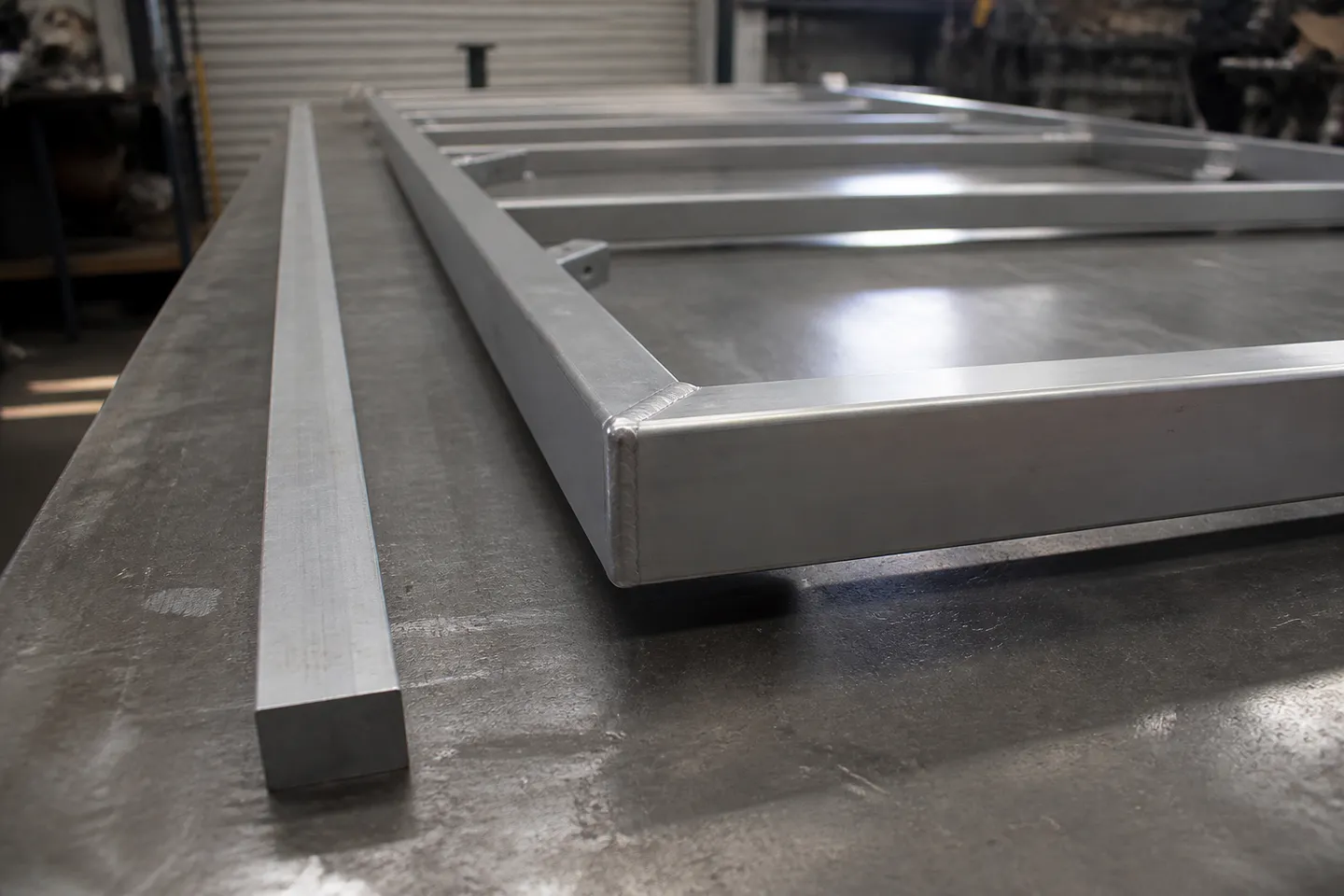
A frame that left the table square can still drop later if the post or hinges give. If that is your problem, see how to fix a sagging metal gate. To get the whole frame right from the start, see how to build a metal gate frame.
Common questions
Why does my gate frame twist after welding?
Usually because most of the weld went on one face, or the table was not flat. Weld both faces in the same opposite-corner order, and check the table with a straight edge before you start.
Should you leave the clamps on until the frame cools?
Yes. Take the clamps off while the welds are hot and the frame moves to wherever the shrinkage pulls it. Wait until you can rest your hand on the corners.
Does tacking stop warping?
It cuts it down a lot. Tack all four corners on more than one face, in opposite-corner order, and check the diagonals before any full weld. Tacks are easy to break and redo.
What is back-step welding?
You work along a joint in one direction but lay each short bead the opposite way, so each one finishes against the last. It spreads the heat and reduces pull on long welds.
Can you heat straighten an aluminium gate frame?
It is a bad idea. Heat that moves aluminium also softens it, and the lost strength only comes back with a heat treatment. Cold straighten with clamps, or cut a corner and re-weld.
Do aluminium frames warp more than other metals?
They tend to. Aluminium grows about 2.3 mm per metre for every 100°C and spreads heat fast, so more of the frame heats and shrinks. Good clamping and a balanced weld order matter more.
Written by Harry Tolley
Harry builds CAD60 with his dad, who has run a fabrication business for 20 years. We write these guides from what goes wrong in a real shop.