On this page
- How big should the gate frame be?
- Which tube should you use for the frame?
- Should the corners be mitred or butt jointed?
- How do you set the frame up flat and square?
- What order do you tack and weld the frame?
- What should you prep for the hinges and latch?
- How do you get the frame ready for powder coat?
- Common questions
A gate frame is four lengths of tube welded into a rectangle. That sounds easy. The hard part is getting it to come off the table flat, square and the right size, so it hangs true and the latch lines up first go.
This guide walks through the whole frame in order: measure, pick the tube, cut, jig, tack, weld, prep for hardware and send it to the powder coater. It assumes aluminium tube, since that is what most gate shops weld now.
What you need to know
- Measure the opening at the top and the bottom, use the smaller number, then take off the hinge and latch gaps.
- Mitre corners need the same tube all round. Butt joints are quicker to cut and leave open ends to cap.
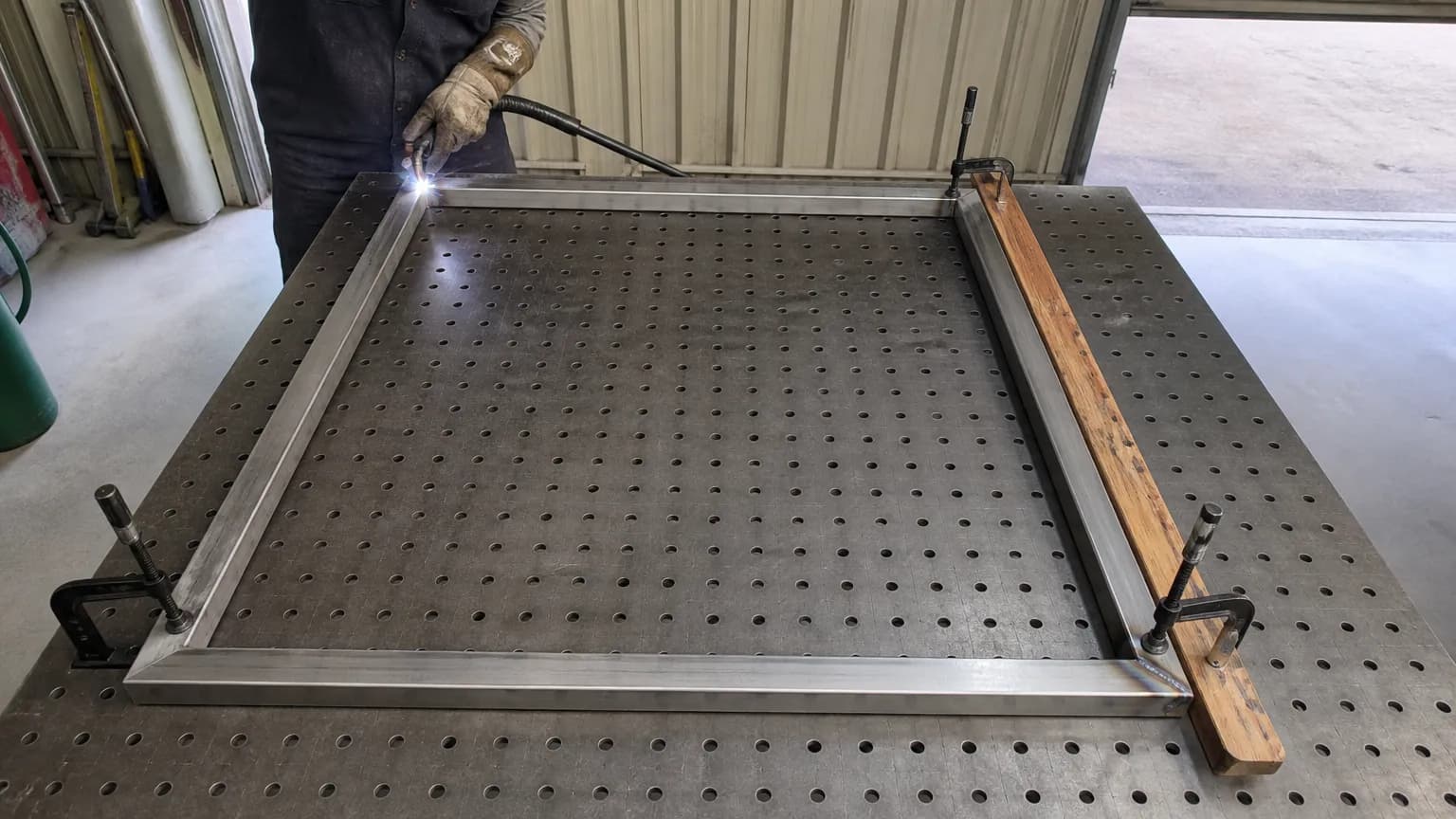
- Clamp the frame flat on a table and check both diagonals before you strike a single tack.
- Tack all four corners first, check again, then weld in short runs on opposite corners.
- Plan hinge and latch positions before welding, and ask the powder coater about drain holes.
How big should the gate frame be?
Start with the clear opening: the space between the two posts. Measure it at the top and at the bottom. Posts are rarely perfectly parallel, so use the smaller number.
Then take off the gaps the gate needs to swing:
- Hinge side gap. Set by the hinge. Some need 15 mm, some roller hinges want over 60 mm. Read the hinge maker's sheet before you cut anything.
- Latch side gap. Set by the latch. Around 8 to 10 mm is common for a lever latch.
- Bottom gap. The ground clearance under the gate. On flat ground 50 mm is a common starting point. Measure the path across the whole swing, because ground that rises will catch the gate.
Worked example: a 1,000 mm opening, a 15 mm hinge gap and an 8 mm latch gap gives a leaf 977 mm wide. If you want more detail on taking measurements on site, see how to measure up a gate job.
Which tube should you use for the frame?
For a pedestrian gate up to about 1.2 m wide, 40x40 or 50x50 SHS with a 3 mm wall is a common pick in aluminium. For a wider leaf, go deeper rather than thicker. A 65x35 RHS stood on its edge resists sag far better than a 50x50 of the same weight.
Wall thickness matters for welding too. A 3 mm wall is much more forgiving than 1.6 mm or 2 mm. Thin aluminium wall blows through fast, and every hole you fill adds heat and pulls the frame.
The RHS vs SHS guide goes through why depth beats wall thickness, with sizes for posts and long rails.
Should the corners be mitred or butt jointed?
Both work. Pick one before you cut, because it changes every length on the cutting list.
A mitre joint cuts both pieces at 45 degrees. It looks clean, has no open tube ends and gives a longer weld at each corner. It needs the same tube on all four sides, and a saw that cuts a true 45. A degree out on each cut adds up to a frame that will not close square.
A butt joint cuts everything square. It is quicker and easier to get right on a drop saw. It also lets you use a different tube on one member, like a heavier bottom rail. The catch is the open end of the rail, which needs an end cap or a welded plate.
Here is the cut list for the 977 mm by 1,800 mm leaf in 40x40x3 SHS:
| Joint | Stiles (x2) | Rails (x2) | Cuts |
|---|---|---|---|
| Mitre | 1,800 mm long point | 977 mm long point | 45 degrees both ends |
| Butt, rails run through | 1,720 mm | 977 mm | Square both ends |
For the butt frame, each stile is the leaf height less two tube depths: 1,800 minus 80 gives 1,720 mm. Mark every piece as you cut it. The gate cut list guide shows how to lay out a full list with infill and offcuts.
How do you set the frame up flat and square?
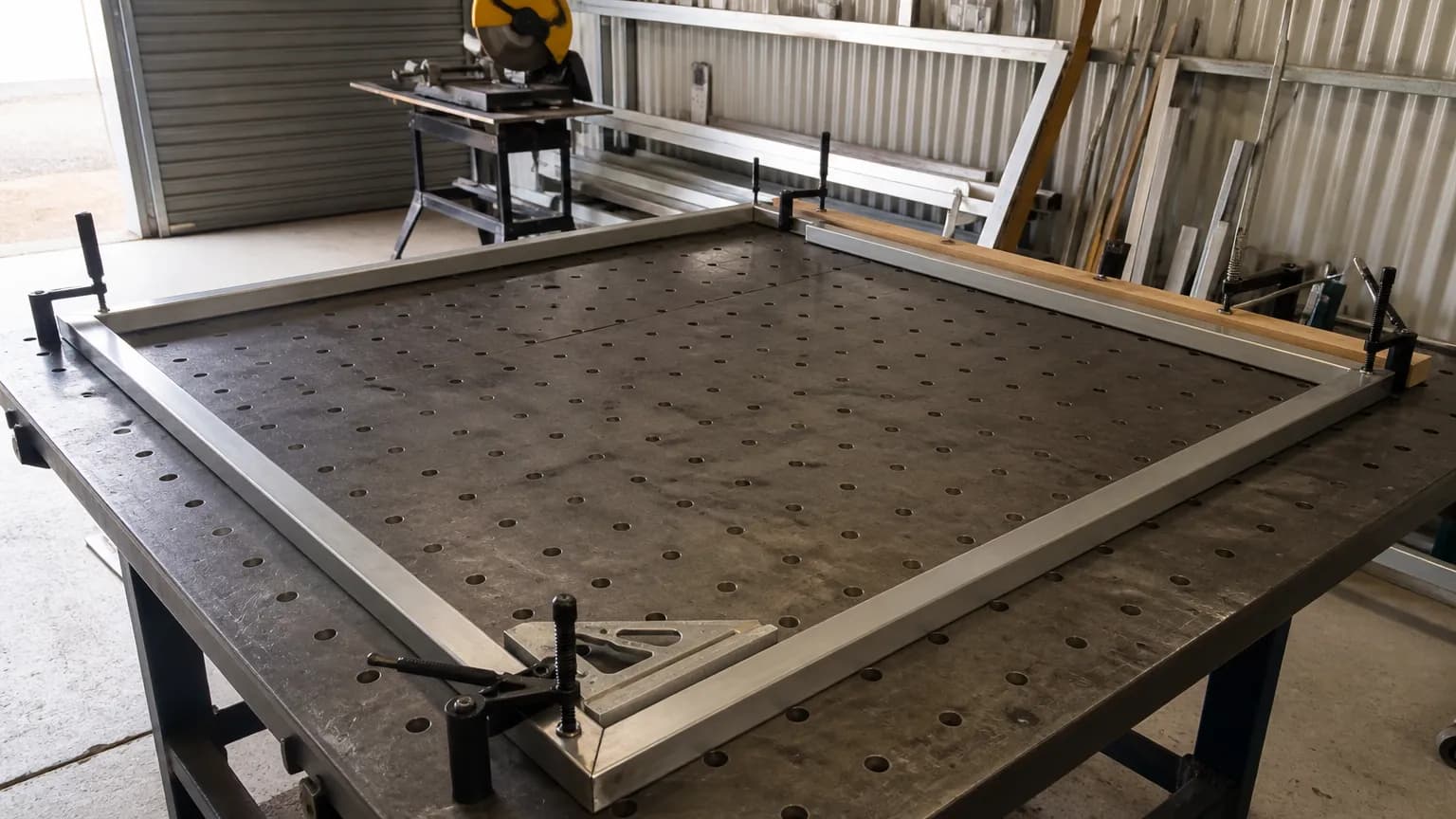
You need a flat table, four or more clamps and a tape. Check the table first. Lay a long straight edge across it both ways. If the table is out, the frame will be too.
- Lay the four pieces out on the table in their final positions.
- Clamp a straight stop block along one long side. Push the hinge stile hard against it.
- Butt the rails up to the stile and set a framing square in each corner.
- Close the frame with the second stile and clamp every corner to the table.
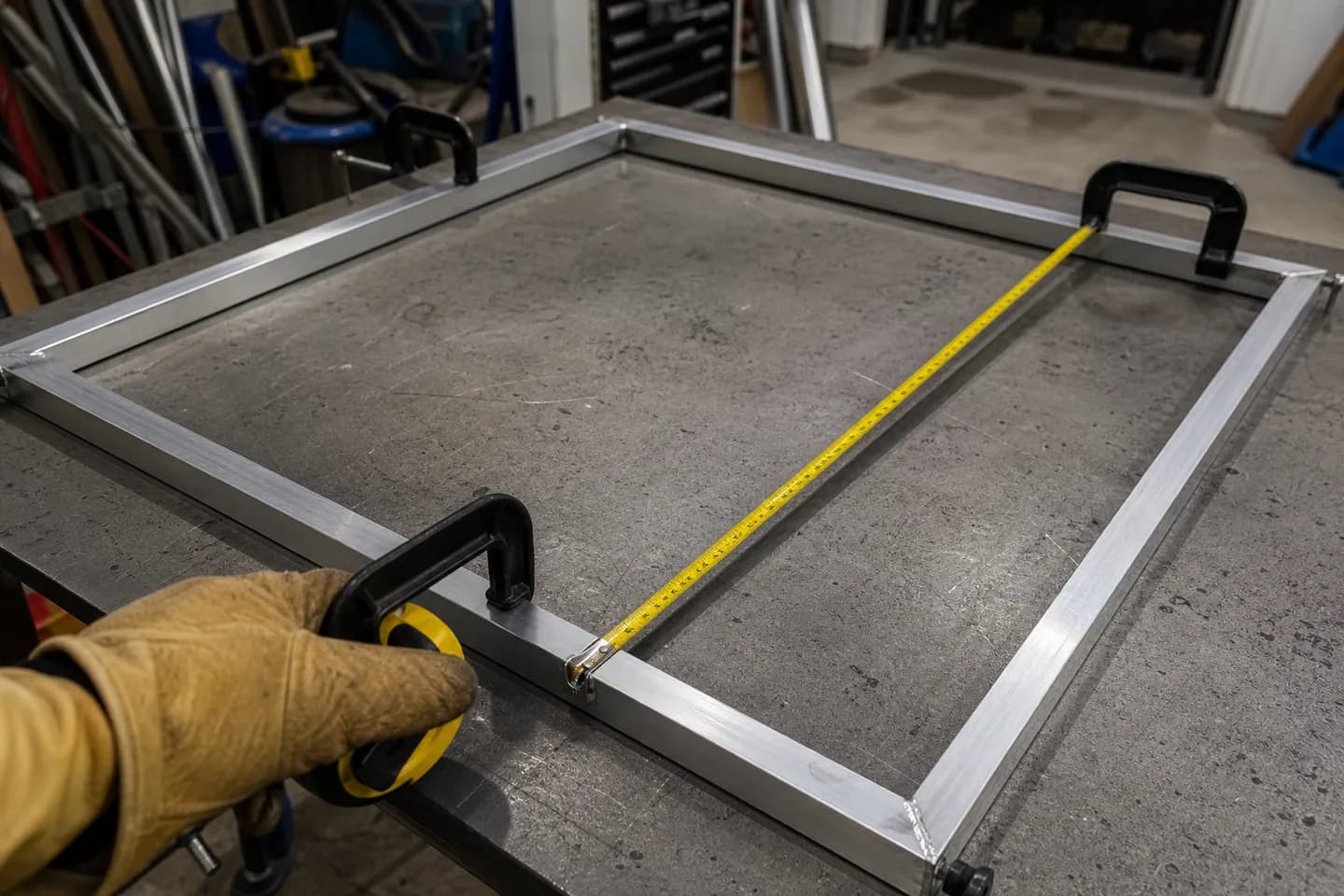
- Measure both diagonals, corner to corner. Tap the frame until the two numbers match.
For our 977 by 1,800 mm leaf, each diagonal should read close to 2,048 mm. Aim to get the two within 2 mm of each other before you tack.
What order do you tack and weld the frame?
Heat makes metal grow, and a cooling weld pulls the joint toward it. The order you weld in decides which way the frame gets pulled. Spread the heat around and the pulls cancel out.
Tack all four corners
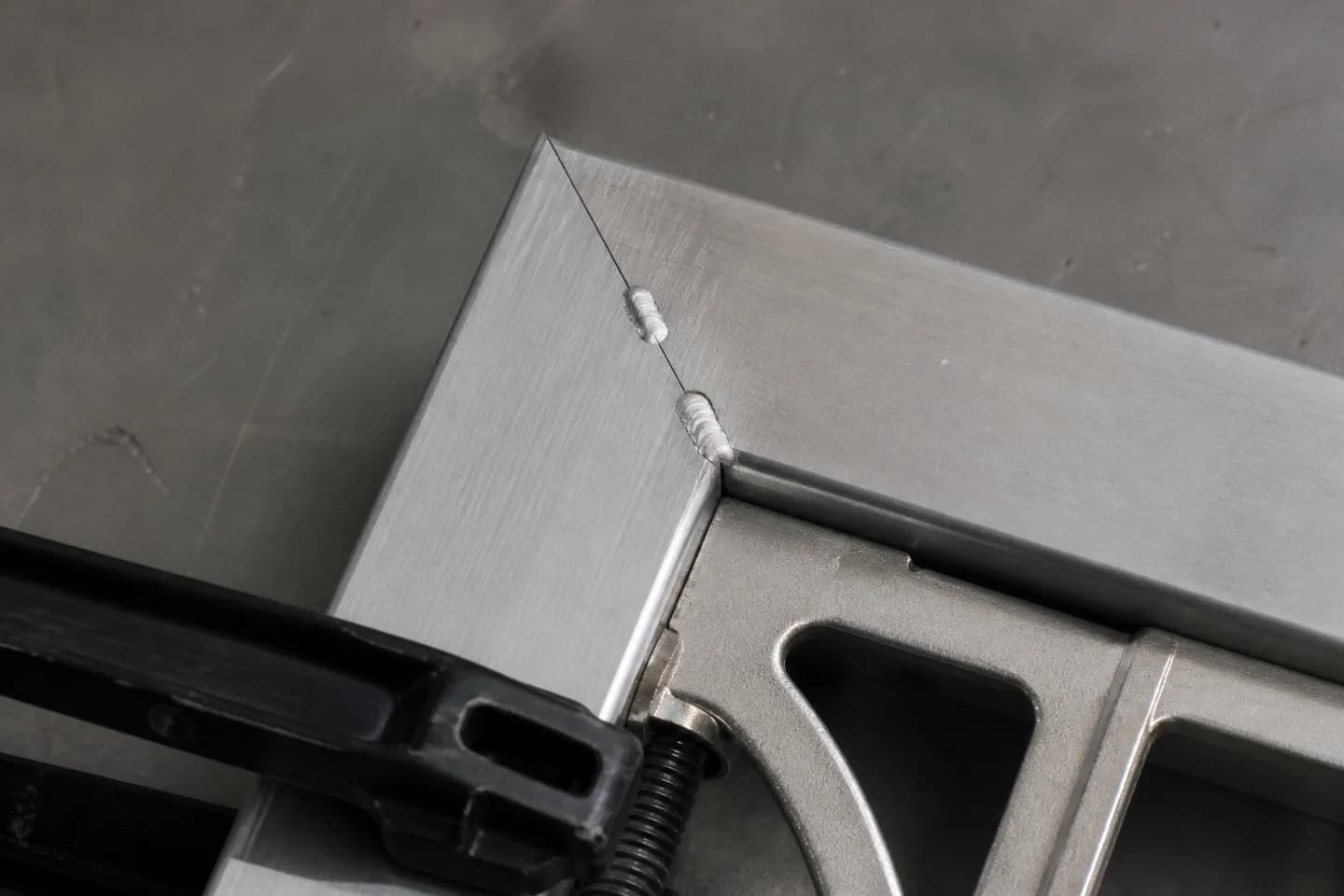
A small tack weld on the face of each corner. Do opposite corners one after the other, not around the frame in a circle.
Check the diagonals again
Tacks pull. If the diagonals have moved, knock the frame back now. A tack is easy to break. A full weld is not.
Tack the other faces
Flip the frame or reach under and tack the back and outside faces too.
Weld in short runs
Weld one face of one corner, then the same face of the opposite corner. Keep going around in that pattern, then flip and do the other side.
Let it cool in the clamps
Leave the clamps on until you can rest your hand on the corners.
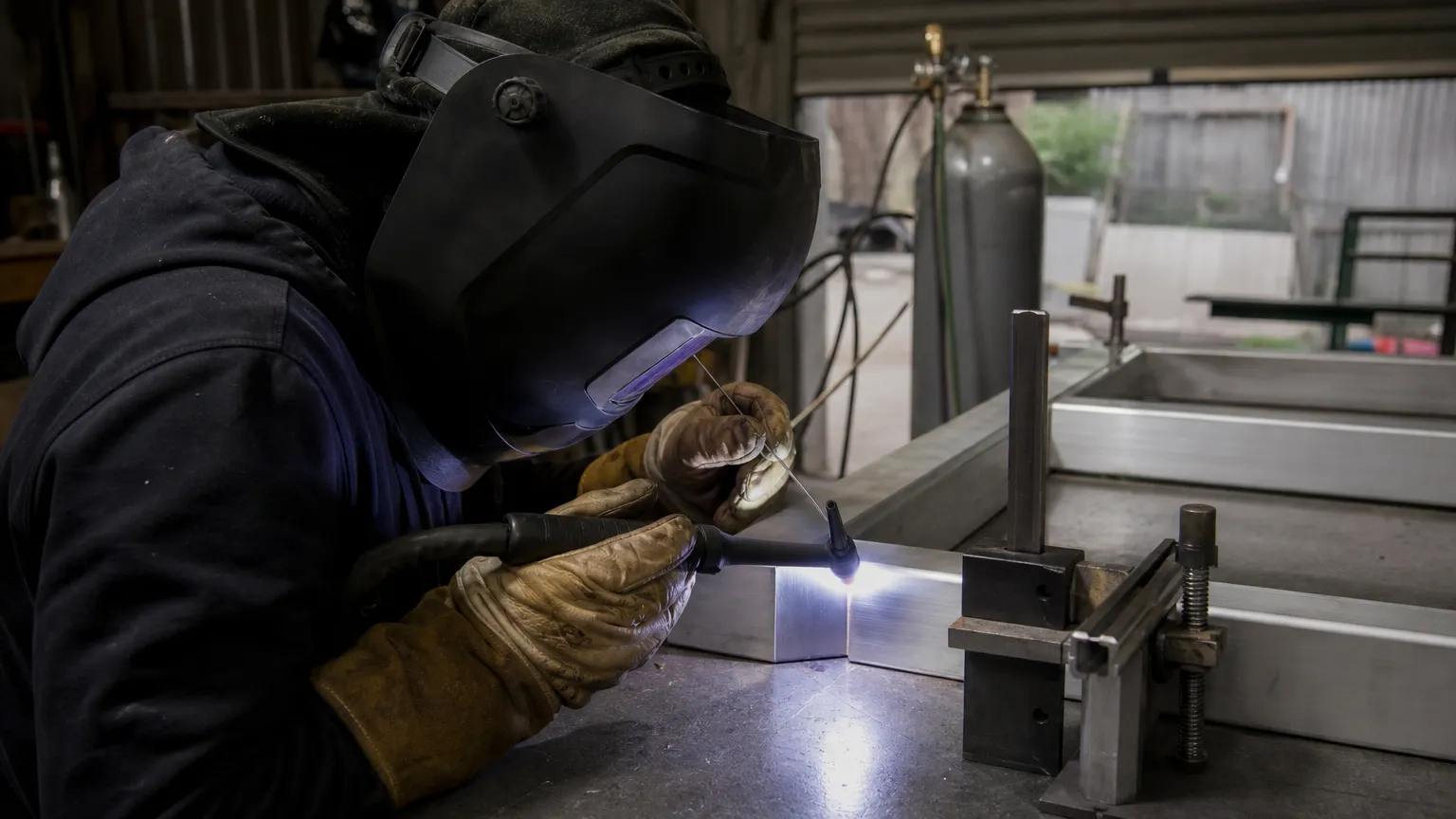
Aluminium needs clean metal, the right filler and pure argon. The aluminium gate welding guide covers settings. If your frames keep coming off the table bent, see how to stop a gate frame warping.
What should you prep for the hinges and latch?
Decide where the hardware goes before the frame is welded. It is much easier to add a plate or a stiffener now than to cut into a finished frame.
- Hinges. Put the top hinge close to the top rail and the bottom hinge close to the bottom rail. The wider apart they are, the less each one has to hold. Mark the heights on the hinge stile.
- Latch. Mark the latch height on the latch stile. Around 1,000 to 1,100 mm off the ground suits most hands.
- Lock box. If the gate takes a lock box, weld it in with the frame, not after. See fitting a lock box.
- Bracing. Past about 1.5 m wide, plan a diagonal brace or a mid rail now.
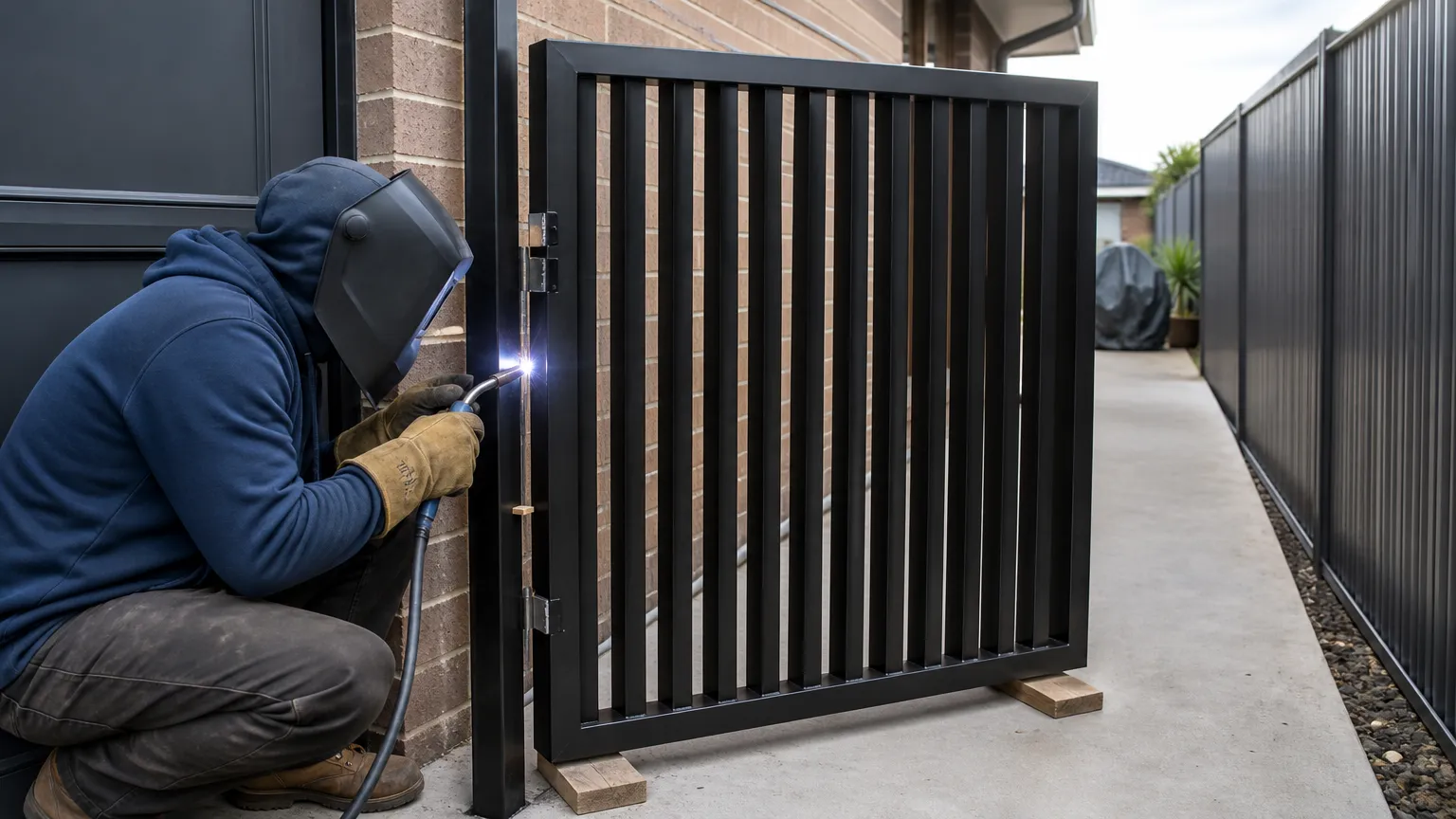
Welding the hinges on comes later, once the gate is on site or set up against its post. The hinge welding guide covers lining the pins up so the gate swings true.
How do you get the frame ready for powder coat?
A powder coat finish shows every lump and pit. Spend ten minutes on prep and the gate looks far better.
- Brush off the black soot (smut) around each weld with a clean wire brush.
- Dress any welds on show with a flap disc made for aluminium. A standard grinding wheel clogs and leaves grit in the metal.
- Cap or plate any open tube ends from butt joints.
- Ask your powder coater if they want drain holes. Pretreatment liquid trapped in a tube can weep out later and spoil the finish.
- Take off the hinge pins and anything else that should not get coated.
A frame that is square, braced and on good hinges will not sag later. If an old one already has, see how to fix a sagging metal gate.
Common questions
What size tube is best for a gate frame?
For an aluminium pedestrian gate, 40x40 or 50x50 SHS with a 3 mm wall is a common choice. Wider leaves want a deeper section, like 65x35 RHS on its edge, rather than a thicker wall.
How much smaller than the opening should a gate be?
Take the hinge gap and the latch gap off the clear opening. With a 15 mm hinge gap and an 8 mm latch gap, a 1,000 mm opening gives a 977 mm leaf. Your hinge sets the real number.
Is a mitre joint stronger than a butt joint?
A mitre has a longer weld at each corner, and a butt joint has more tube end to weld around. Both are strong enough for a gate when welded right. Choose on looks, cutting gear and whether every side is the same tube.
How do you check a gate frame is square?
Measure both diagonals, corner to corner. If they match, the frame is square. Check before the first tack, after tacking and after the final weld.
Can you build a gate frame without a welding table?
Yes, on any surface you have checked flat, like a level slab or sawhorses with a flat beam across them. Clamp the frame down hard and check the diagonals more often.
Should you powder coat aluminium gates?
Most shops do. Powder coat gives an even colour and covers the welds. Clean off the weld soot, dress any welds on show and ask the coater about drain holes before it goes.
Written by Harry Tolley
Harry builds CAD60 with his dad, who has run a fabrication business for 20 years. We write these guides from what goes wrong in a real shop.