On this page
- What are the parts of a weld symbol?
- How do you tell the arrow side from the other side?
- What do the numbers on a fillet weld mean?
- How do you read an intermittent weld?
- What do butt, plug and other weld symbols look like?
- What do the circle, the flag and the tail mean?
- What are the main differences between ISO and AWS weld symbols?
- Common questions
A weld symbol packs a whole sentence into a few lines: which joint, which side, what kind of weld, how big and how long. Once you know where each piece sits, you can read most of them in a few seconds.
The catch is that there are two main ways of drawing them. One uses a single reference line (the American style, which the Australian symbol standard follows). The other is the ISO style with a second, dashed line. You will see both on Australian jobs, so this guide covers both and shows where they differ.
What you need to know
- The arrow points at the joint. The reference line carries the instructions.
- Single-line style: a symbol under the line means the arrow side, above means the other side.
- ISO dual-line style: a symbol on the solid line means the arrow side, on the dashed line the other side.
- A plain number beside a fillet triangle is the leg size. ISO adds a letter: a for throat, z for leg.
- A circle at the bend means weld all round. A flag means weld it on site.
What are the parts of a weld symbol?
Every weld symbol is built from the same pieces:
- The arrow. It points at the joint to be welded. The side it touches is the arrow side.
- The reference line. A horizontal line joined to the arrow. All the other information hangs off it.
- The weld symbol. A small shape on the line that says what type of weld: a triangle for a fillet, a V for a butt, and so on.
- Sizes. The weld size sits to the left of the symbol. The length (and pitch, for a broken weld) sits to the right.
- Extra marks. A circle for all round and a flag for a site weld, both at the bend where the arrow meets the line.
- The tail. An optional fork at the far end for the process, a procedure number or a note.
Read it left to right like a sentence: "At this joint, on the arrow side, run a 6 mm fillet weld, 50 mm long, every 150 mm, by TIG."
How do you tell the arrow side from the other side?
This is the part that trips people up, and it is where the two styles split.
Single reference line (AWS A2.4 and the Australian standard, AS 1101.3, which is based on it). A symbol under the line means weld the arrow side. A symbol above the line means weld the other side. A symbol on both sides means weld both sides. It does not matter which way the arrow points.
Dual reference line (ISO 2553, System A). There is a solid line and a dashed line next to it. A symbol on the solid line means the arrow side. A symbol on the dashed line means the other side. The dashed line can sit above or below the solid one; what counts is which line the symbol touches. When a weld is the same on both sides, the dashed line is left off.
ISO 2553 also has a System B, which uses one line like the American style. A drawing should use one system all the way through, never a mix.
What do the numbers on a fillet weld mean?
The fillet weld is the one you will see most on gate and fence work: frame corners, T-joints, hinges and footplates. Its symbol is a right-angle triangle, always drawn with the upright leg on the left.
- Left of the triangle: size. On single-line drawings a plain number is the leg length. "6" means a 6 mm leg.
- ISO adds a letter. "z6" is a 6 mm leg. "a4" is a 4 mm throat, which works out to a leg of about 5.7 mm on an equal fillet. Mixing up a and z gives you a weld that is too big or too small.
- Right of the triangle: length. No number means weld the full length of the joint.
How do you read an intermittent weld?
An intermittent weld, often called a stitch weld, is a row of short welds with gaps between them. It saves time, heat and distortion on long joints like battens on a frame. The two styles write it differently, and this is where mistakes get made.
- Single-line style: length-pitch. "50-150" means 50 mm welds at 150 mm centres. The pitch is measured centre to centre, so the gap is 100 mm.
- ISO style: n x l (e). n is the number of welds, l is the length of each weld and e, in brackets, is the space between welds. The same weld as above, with 8 runs, reads "8 x 50 (100)".
Same weld, different second number. Read a 150 as a gap when it was a pitch and you put down a quarter less weld than the drawing asks for.
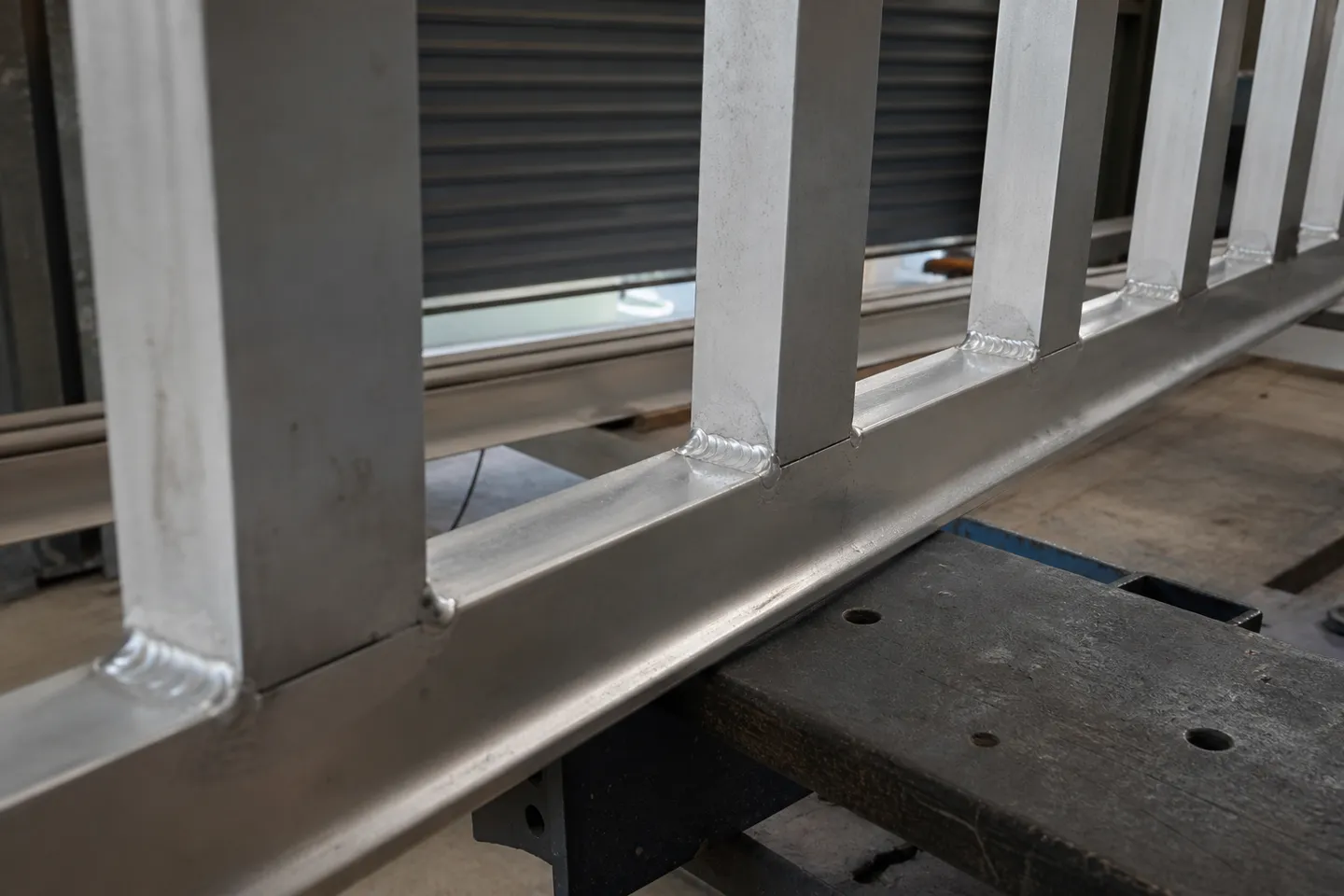
When there are welds on both sides, they can be chained (opposite each other) or staggered (offset, so a weld on one side sits across from a gap on the other). On single-line drawings a staggered weld has its two triangles drawn offset along the line.
What do butt, plug and other weld symbols look like?
The shape on the line tells you the type of weld. A butt weld is called a groove weld on American drawings. These are the ones a gate or fence shop meets most.
| Weld | What the symbol looks like | Where you see it |
|---|---|---|
| Fillet | Right-angle triangle, upright leg on the left | Frame corners, T-joints, hinges, footplates |
| Square butt | Two short upright lines | Thin flat bar or sheet joined edge to edge |
| Single V butt | A V shape | Thicker plate joined edge to edge, both edges bevelled |
| Single bevel butt | Half a V, upright leg on the left | Only one edge bevelled. The arrow points at the piece that gets the bevel |
| Plug or slot | A small rectangle | Welding a top plate through a hole or slot into the piece below |
A short straight line drawn over the symbol means the weld face is finished flush. On American drawings a letter can follow it to say how, such as G for grind. See butt weld and plug weld in the glossary for more.
What do the circle, the flag and the tail mean?
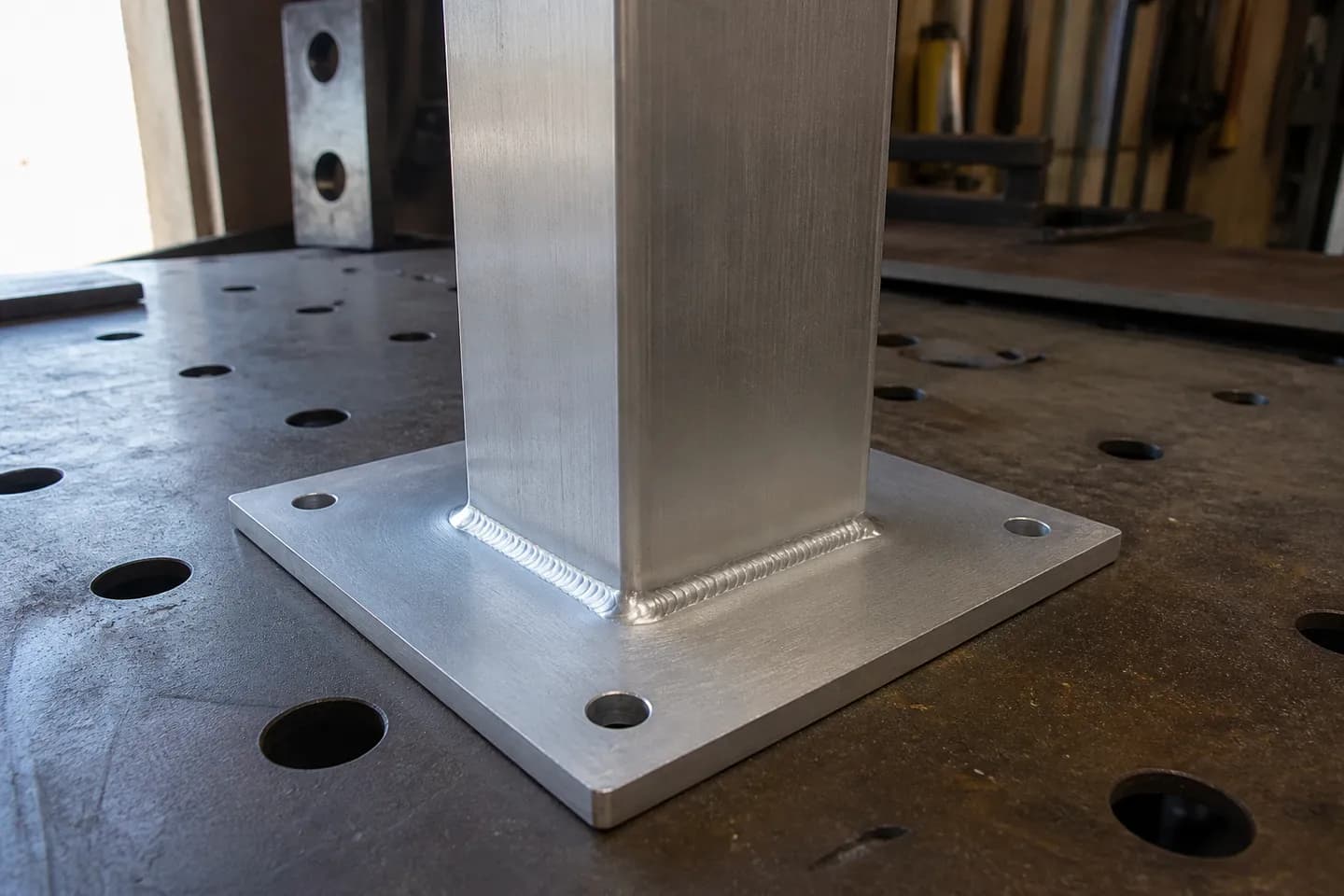
- Circle at the bend: weld all round. Run the weld right around the joint. You see it on posts welded to footplates and on tube going through plate.
- Flag at the bend: site weld. This weld is done on site, not in the shop. Plan for it: the part ships with that joint open, and someone takes a welder to the job.
- Tail: extra information. The process, a procedure number or a note. ISO drawings use process numbers, such as 131 for MIG and 141 for TIG. American drawings use letters, such as GMAW for MIG and GTAW for TIG.
What are the main differences between ISO and AWS weld symbols?
Before you read a single size, find out which system the drawing uses. It is often in the title block or the general notes. A dashed line next to the reference line is a sure sign of ISO System A.
| ISO 2553 (System A) | AWS A2.4 style | |
|---|---|---|
| Reference line | Solid line plus a dashed line | One solid line |
| Arrow side | Symbol on the solid line | Symbol under the line |
| Other side | Symbol on the dashed line | Symbol above the line |
| Fillet size | Letter and number: a4 (throat), z6 (leg) | Number only: 6 is the leg |
| Intermittent | n x l (e), e is the space between welds | Length-pitch, pitch is centre to centre |
| Edge to edge weld | Butt weld | Groove weld |
| Process in the tail | Numbers (131, 141) | Letters (GMAW, GTAW) |
If you draw your own frames, keep it simple. Most gate and fence drawings get by with one general note, such as "all joints welded all round unless noted", plus a symbol where a joint is different. The how to draw a fabrication drawing guide covers weld notes, and how to weld an aluminium gate covers the welding itself.
Common questions
Which side of the line is the arrow side?
On single-line drawings, under the line is the arrow side and above is the other side. On ISO System A drawings, the solid line is the arrow side and the dashed line is the other side.
What does a dashed line on a weld symbol mean?
It means the drawing uses ISO 2553 System A. A symbol on the dashed line is a weld on the other side of the joint, away from the arrow. A symbol on the solid line is on the arrow side.
What does the number next to a fillet weld symbol mean?
The number on the left is the weld size, usually the leg length in mm. On ISO drawings an a in front means throat size and a z means leg size. A number on the right is the weld length.
What does a circle on a weld symbol mean?
A circle where the arrow meets the reference line means weld all round. Carry the weld right around the joint, such as a post welded to its base plate.
What does the flag on a weld symbol mean?
The flag means a field or site weld. That joint is welded on site during install, not in the workshop. No flag means it is a shop weld.
What does 50-150 mean on a weld symbol?
On a single-line drawing it is an intermittent weld: 50 mm long welds at 150 mm centres, leaving 100 mm gaps. On an ISO drawing the gap is written in brackets instead, so check which system the drawing uses.
Does the arrow direction change the meaning of a weld symbol?
No. The arrow can point left, right, up or down. What matters is which side of the joint it touches and where the symbol sits on the reference line.
Written by Harry Tolley
Harry builds CAD60 with his dad, who has run a fabrication business for 20 years. We write these guides from what goes wrong in a real shop.