On this page
- How do you work out how many pool fence panels you need?
- What size are aluminium pool fence panels?
- How many panels and posts does my run need?
- What do you do with the last, short panel?
- How does a gate change the count?
- How do you count corners and a fence that goes all the way round?
- What else goes on the order?
- Common questions
Counting pool fence panels looks easy until the last bay. Divide the run by the panel width and you get a number like 4.08. So do you order four panels or five? And how many posts?
This guide shows the sum that gets it right, the common aluminium panel sizes, and what to do with the short panel at the end. There is a calculator in the middle that does the sum for you.
What you need to know
- Each bay is one panel plus one post. Divide the run by that, and round up.
- A straight run needs one more post than it has panels.
- Common aluminium panels are 2400 mm and 2450 mm wide. Some suppliers also stock 3000 mm.
- The last bay is usually a cut panel. If it is tiny, cut the last two panels to the same width.
- A gate takes a bay of its own and adds one post to the run.
How do you work out how many pool fence panels you need?
Think in bays, not panels. A bay is one panel and the post beside it. For a 2400 mm panel and a 50 mm post, one bay is 2450 mm.
Measure the run
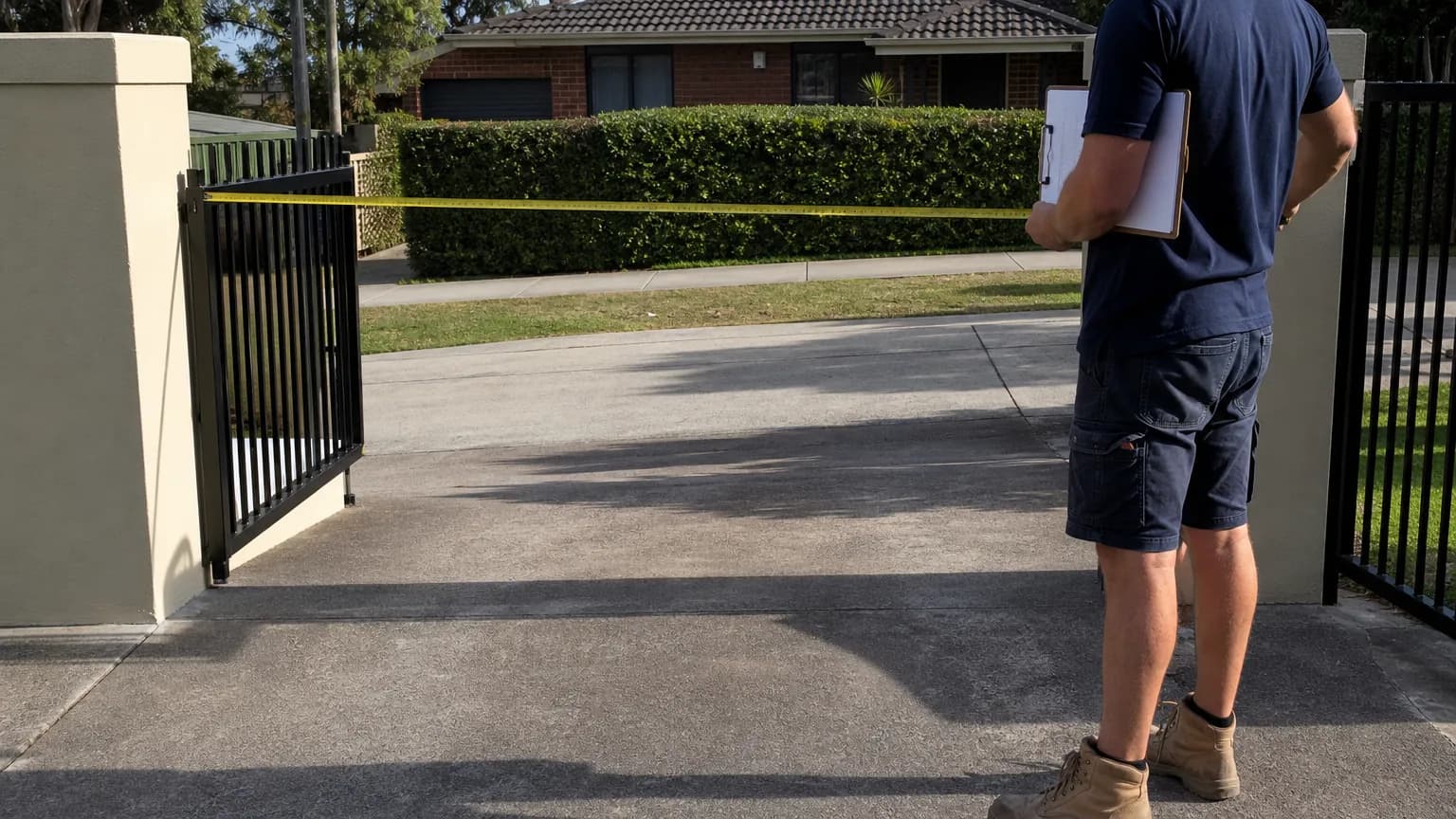
Measure from the outside of the first post to the outside of the last post. One straight line at a time.
Take off the first post
The first post has no panel before it. Take its width off the run.
Divide by one bay and round up
That gives you the number of panels. Whole bays are full panels. The part left over is a cut panel.
Add one for the posts
Posts are the panel count plus one, for a straight run with no gate.
Here is an example. A 12,000 mm run with 2400 mm panels and 50 mm posts. Take off the first post and you have 11,950 mm. That fits four full bays of 2450 mm (9,800 mm), with 2,150 mm left. The last post takes 50 mm of that, so the cut panel fills 2,100 mm. That is five panels and six posts.
What size are aluminium pool fence panels?
Most aluminium flat-top panels are 2400 mm or 2450 mm wide. Bunnings' Protector Aluminium range has been moving from 2450 mm to 2400 mm, Stratco still lists 2450 mm, and some suppliers, like Oxworks, also stock 3000 mm. Check the exact width with your supplier before you set a single post.
| Panel width | Post | Post centres (supplier figure) |
|---|---|---|
| 2450 mm | 50 mm | 2500 mm (Bunnings Protector) |
| 2400 mm | 50 mm | 2450 mm (Bunnings Protector), 2455 to 2460 mm (Oxworks) |
| 3000 mm | 50 mm | 3055 to 3060 mm (Oxworks) |
The small differences come from the brackets. Some systems want a few millimetres of play between the panel and the post. Oxworks says to allow 5 to 10 mm. In the calculator, add that allowance to the panel width.
How many panels and posts does my run need?
Type in one straight run. If the run has a gate, type the gap between the two gate posts. The calculator gives you the panel count, the post count and the width of the cut panel in the last bay.
Fence panel calculator
One straight run. Work out each side of a pool on its own.
Outside of the first post to outside of the last post.
Panel width, plus any bracket allowance your supplier gives (often 0 to 10 mm).
50 mm is common for aluminium posts.
Gap between the two gate posts. Leave 0 for no gate.
Panels
5
4 full, 1 cut
Posts
6
Cut panel gap
2,100 mm
The last bay, post to post.
The cut panel width is the gap from post to post in the last bay. If your system needs a bracket allowance, cut the panel that much shorter.
What do you do with the last, short panel?
Cut a full panel down to fit. Aluminium panels cut easily with a 1 mm cutting disc in a grinder or a hacksaw, and on most systems the cut end hides inside the bracket. Clean off the burr and touch up the powder coat on the cut end.
The problem is when the leftover is tiny. Take a 10,000 mm run with 2400 mm panels and 50 mm posts. Four full bays leave a last bay only 100 mm wide. A 100 mm sliver of fence looks like a mistake.
The fix is to share it out. Take the last full panel and the sliver together, and cut two equal panels instead: (2400 + 100) divided by 2 is 1,250 mm each. Same number of panels and posts. It just looks planned. The calculator tells you when a cut panel is narrow enough to do this.
How does a gate change the count?
A gate takes a bay of its own, between two gate posts. One of those posts is shared with the panels. So a gate adds one post to the run, and takes the gate gap out of the length left for panels.
The gate gap is the gate width plus the gaps the hinges and latch need. Each gate kit is different. Oxworks, for example, says to set its gate posts 1000 mm apart for its standard kit. Get the number for the kit you are fitting, and type it into the calculator as the gate gap. For hardware, see the pool gate hinges and latches guide.
How do you count corners and a fence that goes all the way round?
Work out each straight side as its own run, measured to the outside of its corner posts. Add the sides up. Then take off one post for every corner, because each corner post was counted twice.
Here is a fence round a 12 m by 6 m pool area, with a gate in one short side:
| Side | Run | Panels | Posts |
|---|---|---|---|
| Long side 1 | 12,000 mm | 5 (one cut to 2,100 mm) | 6 |
| Long side 2 | 12,000 mm | 5 (one cut to 2,100 mm) | 6 |
| Short side | 6,000 mm | 3 (one cut to 1,000 mm) | 4 |
| Short side with 1000 mm gate | 6,000 mm | 2 (both full) | 4 |
| Less 4 shared corner posts | -4 | ||
| Total | 15 | 16 |
A quick check for a closed loop: the posts should equal the panels plus the gates. Here that is 15 plus 1, so 16.
What else goes on the order?
Panels and posts are the big items. Do not forget the rest:
- Brackets for both ends of every panel, and the screws to fix them.
- A cap for every post.
- The post fixing: in-ground posts and concrete, or footplate posts and anchors for a slab, or core-drilled posts and grout.
- The gate, its hinges, its latch and the gate posts.
- Touch-up paint for the cut ends.
Measure the site properly before you order. The measure-up guide covers levels, falls and what to photograph.
Common questions
How many posts do I need for a pool fence?
For one straight run, one more post than panels. Add one post for each gate. For a fence that goes all the way round, the posts equal the panels plus the gates.
How far apart are pool fence posts?
The panel width plus the post width, plus any bracket allowance. For a 2400 mm panel and a 50 mm post, suppliers give post centres from 2450 mm to about 2460 mm.
Can you cut aluminium pool fence panels?
Yes. A grinder with a 1 mm cutting disc or a hacksaw does it. On most systems the cut end sits inside the bracket. Deburr it and touch up the powder coat.
Are pool fence panels 2400 or 2450 wide?
Both are common. Some ranges have moved from 2450 mm to 2400 mm, and some suppliers also stock 3000 mm. Confirm the width with your supplier before you set out posts.
Should I order a spare panel?
It is cheap insurance. A spare covers a panel damaged in transit or a cut that goes wrong, and saves a second trip to the supplier halfway through the install.
How do I measure a pool fence run?
Measure each straight side from the outside of its first post to the outside of its last post. Treat every change of direction as a new run, and count each corner post once.
Written by Harry Tolley
Harry builds CAD60 with his dad, who has run a fabrication business for 20 years. We write these guides from what goes wrong in a real shop.