On this page
- What hardware does a pool gate need?
- Which self-closing hinges should you fit?
- Should you fit a top-pull or side-pull magnetic latch?
- How do pool gate hinges and latches mount on aluminium posts?
- How do glass pool gate hinges and latches mount?
- How do you adjust the closing speed and tension?
- Why won't a pool gate close or latch properly?
- Watch it done in CAD60
- Common questions
Two bits of hardware decide whether a pool gate works. The hinges have to pull it shut every time. The latch has to catch it every time. When a pool gate gives trouble, it is almost always one of those two, or the way they were fitted.
This guide is about the hardware itself: what to fit on aluminium posts and on glass, how it mounts, how to set the tension and speed, and how to fix the usual faults. It names real products because that is what you will be ordering.
What you need to know
- Fit a pair of self-closing hinges rated above the weight of the leaf.
- A magnetic latch like the MagnaLatch catches gently, even when the gate closes slowly.
- On aluminium posts, use post-mount hinges and a top-pull latch. On glass, use clamp hinges and a glass latch.
- Set the hinge tension so the gate closes from any angle without slamming.
- Most faults come from sag, misaligned hinges or too much tension, not broken parts.
What hardware does a pool gate need?
Two things that work as a team:
- Self-closing hinges that pull the gate shut from any open position. A spring does the pulling. Some hinges add a hydraulic or damped soft close to slow the last part of the swing.
- A self-latching latch that catches the gate as it arrives, with no push needed. On most pool gates that is a magnetic latch, often called a magna latch after the best-known brand.
The two have to be matched. A strong hinge that slams the gate can bounce it off the latch. A weak hinge that crawls the last 100 mm may never reach it. Most of this guide is about getting that balance right.
Which self-closing hinges should you fit?
These are the hinges you will see on most pool gates in Australia. Check the weight rating against your leaf. The ratings below are from each maker's published specs.
| Hinge | Suits | How it closes | Rated to |
|---|---|---|---|
| D&D KwikFit (aluminium) | Light aluminium gates on posts or walls | Stainless torsion spring, 6 tension settings | 20 kg |
| D&D TruClose Regular | Metal and timber gates on posts | Stainless spring in a polymer body, adjustable tension | About 30 kg a pair |
| D&D TruClose Heavy Duty | Heavy or busy gates | As above, bigger spring | About 70 kg |
| Locinox hydraulic closers | Metal gates that need a controlled close | Hydraulic, adjustable speed and final snap | Model dependent |
| Polaris soft close | Frameless glass gates | Spring plus soft-close damper | About 45 kg a pair |
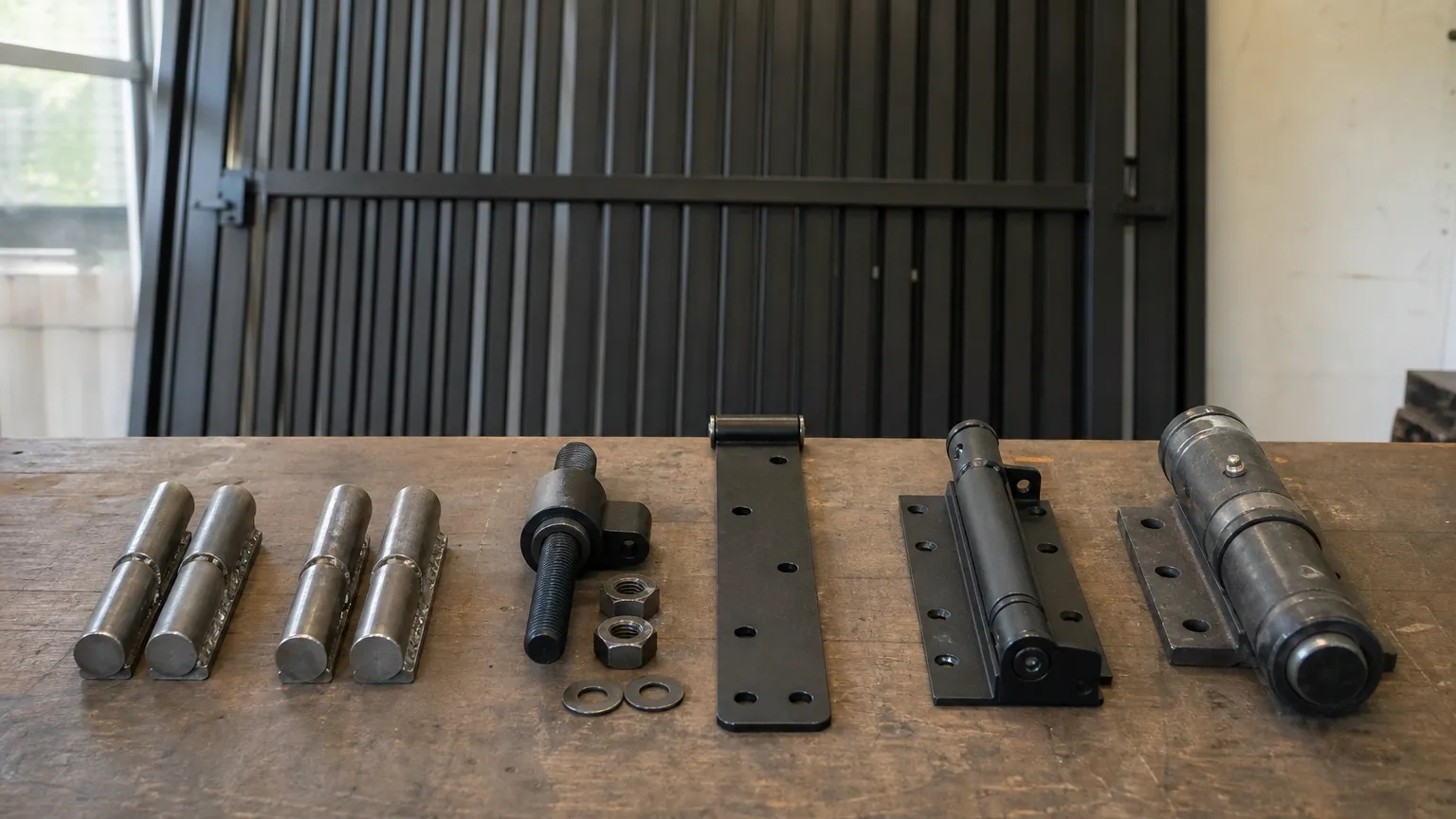
For an aluminium pool gate with a bar or batten infill, a pair of KwikFit or TruClose hinges is the usual pick. They bolt on, need no welding and do not need oil. Locinox makes closers that sit on the post, like the Lion, and the Interio that hides inside the gate frame. They suit heavier or wider gates where you want a smooth, controlled close. For hinges on everyday gates, see the gate hinge types guide.
Should you fit a top-pull or side-pull magnetic latch?
Both are D&D MagnaLatch models. Both latch with a magnet, so there is no spring catch to jam. The difference is where the release sits and what they mount to.
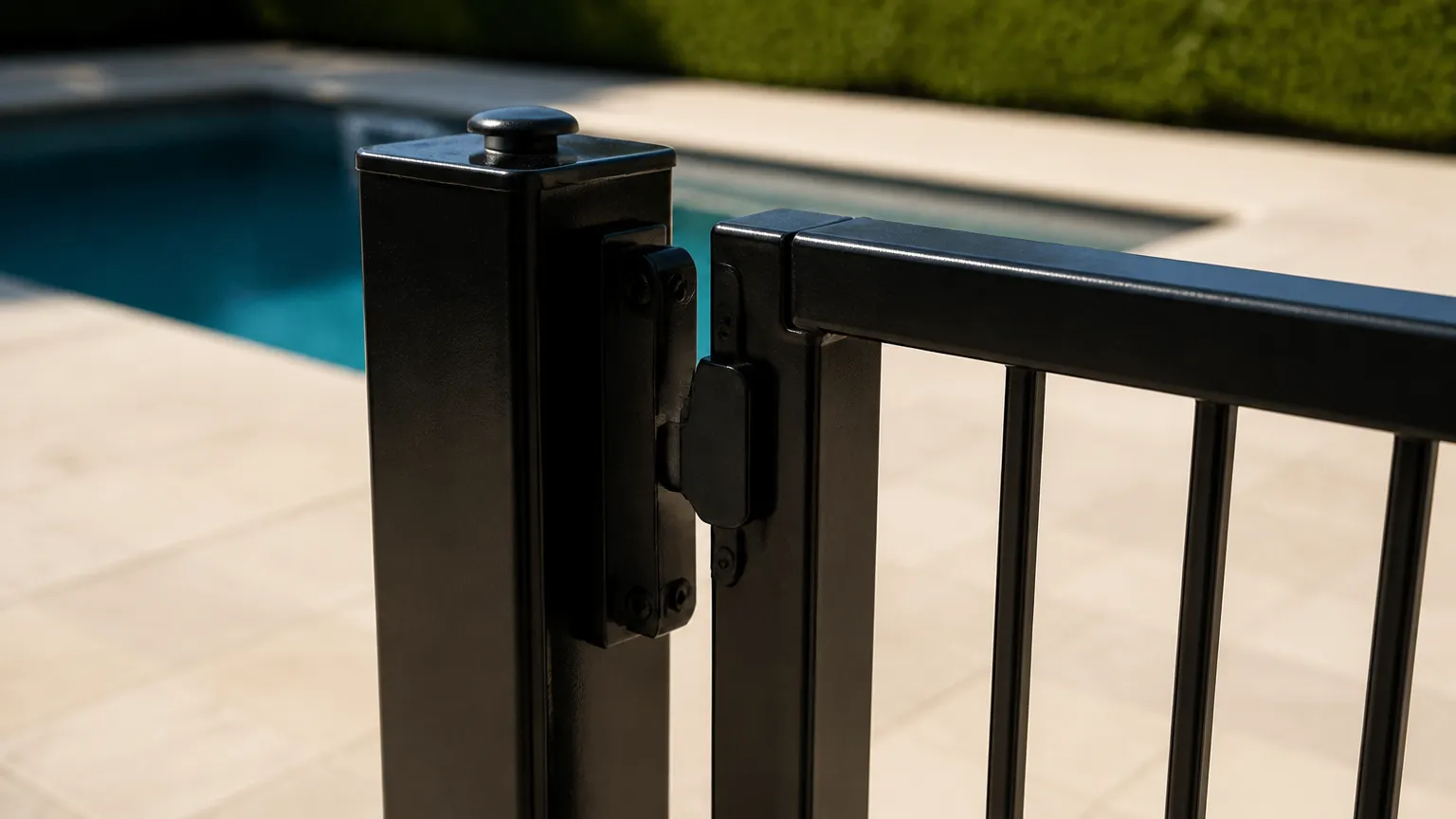
- Top pull. The latch body sits up the post with the release knob on top. You lift the knob to open. The Series 3 Top Pull is lockable, adjusts up, down and sideways, and has marks that show when it needs adjusting. It suits square posts of 25 mm and up, and is listed for aluminium, timber and vinyl gates. D&D gives the ideal gate-to-post gap as 19 mm, with a working range of 10 to 37 mm.
- Side pull. A compact latch you open by pulling a knob sideways. Its ideal gap is 8 mm, it has 10 mm of adjustment both ways, and it comes in a version for 8 or 10 mm glass and a stainless glass-to-glass model. It suits home and garden gates and some pool gates.
On an aluminium pool gate with square posts, the Top Pull is the one you will fit most. On frameless glass, it is a glass-mount latch: the Side Pull glass version, or the latch that comes with the glass hinge system.
How do pool gate hinges and latches mount on aluminium posts?
They screw on. That makes them quick to fit, but the hole and the gap are what decide whether the gate works.
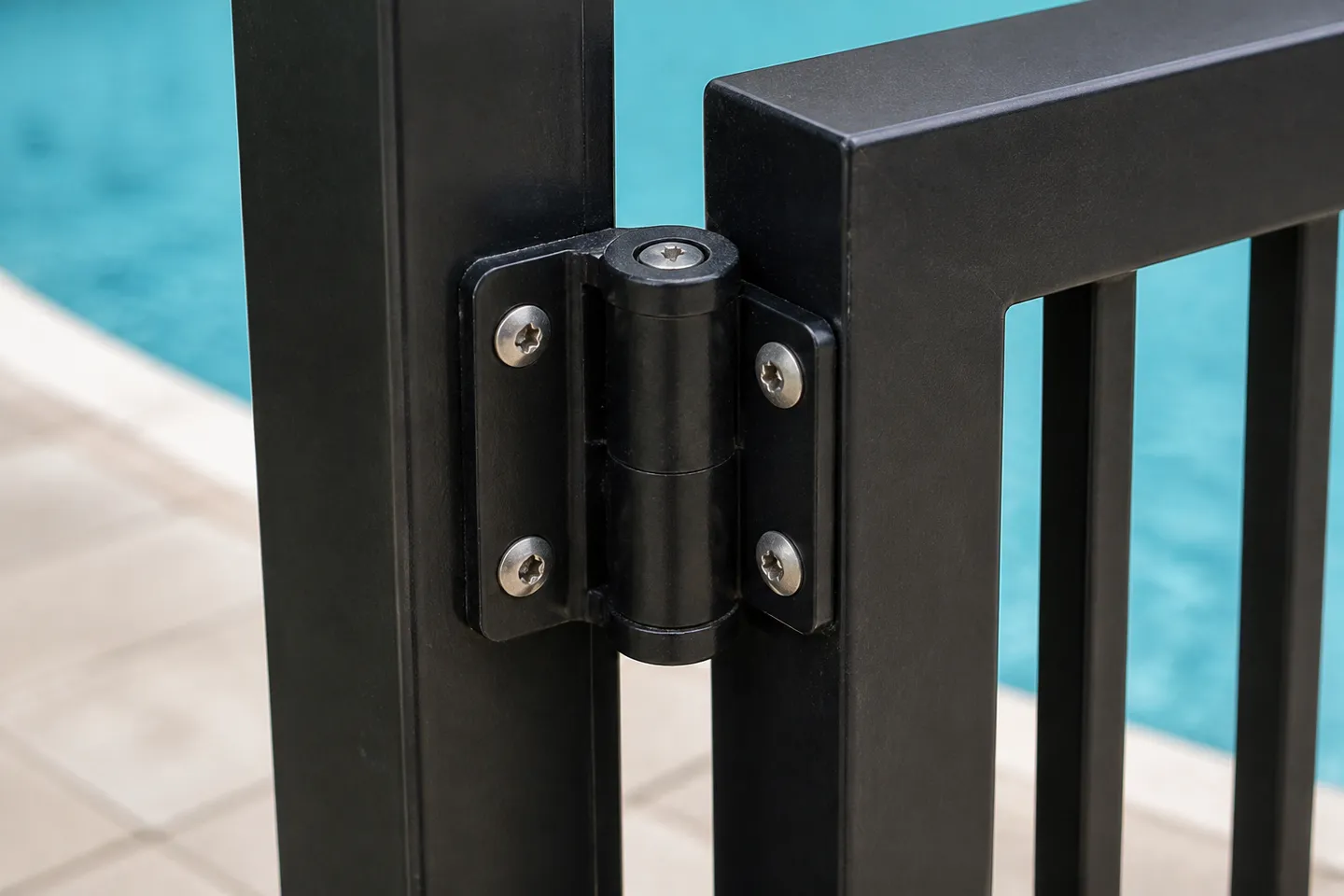
- Set the hinge gap first. Many self-closing hinges have a fixed gap built in. The KwikFit range is fixed at 13, 19 or 21.5 mm depending on the model. Build the leaf to suit, or the latch side ends up too tight or too wide.
- Line up the pivots. Both hinges need to turn on one straight, vertical line. Put a level on the edge of the gate and pack the hinges until it is plumb before you drive the last screws.
- Use the right fixings. D&D recommends 12 gauge screws for the KwikFit. Use stainless. Pre-drill the post, and do not over-tighten into thin wall tube or the thread strips. A 3 mm wall post holds screws far better than 1.6 mm.
- Fit the latch body to the post, the striker to the gate. For the Top Pull, the instructions call for a 3 mm gap between the bottom of the latch and the top of the striker. A gap spacer kit covers bigger post gaps and a round post adaptor covers round posts.
Fit the hardware with the gate hung and closed, not on the bench. Small errors in the posts show up at the latch.
How do glass pool gate hinges and latches mount?
Glass hinges clamp through holes or cut-outs in the glass. That is the big difference from metal: toughened glass cannot be drilled after it is toughened. The holes have to be in the right place before the glass is made. Polaris supplies templates with the hole spacing and edge distances for this reason.
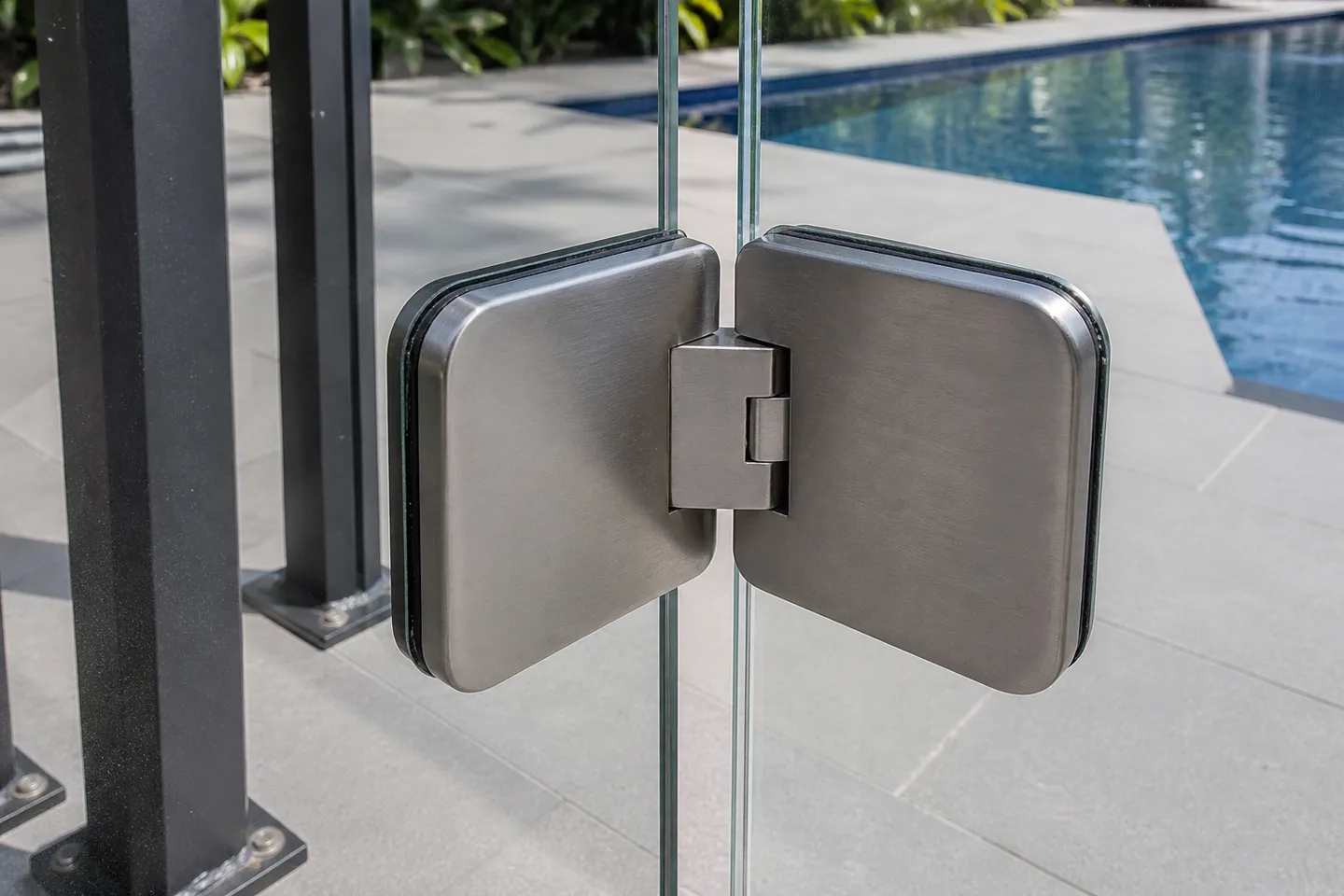
There are three common layouts:
- Glass to glass. The gate hangs off a fixed glass hinge panel. The cleanest look, and the most common on frameless fences.
- Glass to wall. The hinges fix to a wall or a solid pier.
- Post to glass. The hinges fix to an aluminium or stainless post, with the glass gate hanging off it.
Match the hinge to the glass thickness. Most systems suit 8, 10 or 12 mm toughened glass, but not every model takes every thickness. Polaris hinges are duplex stainless and rated about 45 kg a pair. A heavy or tall gate needs a third hinge.
How do you adjust the closing speed and tension?
Set tension so the gate closes from anywhere, then set speed so it arrives gently. Go one step at a time.
Start low
Set both hinges to a low tension setting. On a KwikFit that is a 6 mm slot screwdriver in the top of the hinge. Keep both hinges on the same setting.
Test from fully open
Open the gate all the way and let go. Do not push it. If it stops short of the latch, add one step of tension to each hinge and try again.
Test from a small opening
Open the gate about 100 to 200 mm and let go. This is where a weak setting fails, because the spring has the least wind left.
Slow the last part of the swing
On hydraulic and soft-close hinges, turn the speed adjuster until the gate arrives without a bang. Polaris uses an Allen key or a ratchet cap and offers three damper strengths. Locinox closers adjust speed and the final snap separately.
Check the latch catches every time
Close the gate ten times from different angles. Every close should latch. If the gate bounces off, back the tension or speed off a step.
Do not keep winding a spring that has stopped helping. Polaris warns against this. If the gate still will not close, the problem is somewhere else, usually sag or binding.
Why won't a pool gate close or latch properly?
Work through the likely causes before you replace anything.
| What you see | Likely cause | Fix |
|---|---|---|
| Gate bounces off the latch | Too much tension or speed | Back the tension off a step. Slow the soft close. |
| Gate stops just short | Too little tension, or the hinges bind | Add a step of tension. Check the pivots line up and the brands match. |
| Striker hits above or below the latch | The gate or post has dropped | Adjust the latch up or down. Then find the sag: post, hinges or frame. |
| Gate drags on the ground | Sag, or the ground has moved | Re-set the hinges or the post. Raise the leaf if pavers lifted. |
| Wind holds it open | Hinges too weak for the site | Add tension, or a magnetic closer like the Polaris Powerclose. |
| Won't close at any setting | Worn or tired spring | Replace the hinge pair. Do not mix old and new. |
Sag is behind a lot of latch trouble. If the striker keeps creeping down, the hardware is not the real problem. The guide on fixing a sagging metal gate walks through post, hinges and frame.
Keep the latch clean, too. D&D says to keep sand and grit out of the release knob and latching bolt, and to lubricate only with powdered graphite, never oil.
Watch it done in CAD60
Common questions
How many self-closing hinges does a pool gate need?
Two, rated above the weight of the leaf. A heavy, tall or wide gate gets a third. Polaris recommends a third hinge on gates over about 1.8 m and on heavy metal gates.
Can you add self-closing hinges to an existing gate?
Yes. Bolt-on hinges like the D&D KwikFit and TruClose replace the old ones with screws. Locinox also makes closers that bolt onto an existing gate. Check the hinge gap suits your gate first.
Do magnetic latches work on aluminium gates?
Yes. The magnet works between the latch and its striker, not on the gate itself, so the gate material does not matter. D&D lists the MagnaLatch Top Pull for aluminium, timber and vinyl gates.
Why does my glass pool gate slam?
The spring tension is too high or the soft-close damper is too weak. Back the tension off, then slow the close with the speed adjuster. On Polaris hinges you can also swap to a stronger damper.
Do TruClose hinges need oil?
No. They are glass-fibre reinforced polymer with a stainless spring, and they are sold as never needing lubrication. Keep them clean and check the tension and screws now and then.
What gap does a MagnaLatch need?
D&D gives 19 mm as the ideal gap between gate and post for the Series 3 Top Pull, with a working range of 10 to 37 mm. The Side Pull is happiest at about 8 mm. Spacer kits cover bigger gaps.
Written by Harry Tolley
Harry builds CAD60 with his dad, who has run a fabrication business for 20 years. We write these guides from what goes wrong in a real shop.