On this page
- How does a telescopic gate work?
- How much room does a telescopic gate save?
- When should you use a telescopic gate?
- When is a single sliding gate the better pick?
- Is a telescopic gate the same as a bi-parting or bi-fold gate?
- How do you size the leaves?
- What are the downsides of a telescopic gate?
- Common questions
A normal sliding gate needs room beside the opening for its whole length. On a lot of sites that room is not there. A wall, a garage or the boundary gets in the way.
A telescopic gate fixes that by splitting the gate into two or three leaves. They slide past each other and stack up beside the opening, like the sections of a telescope. This guide covers how it works, how much room it saves and when it is worth the extra hardware.
What you need to know
- A telescopic gate splits one sliding gate into two or three leaves on parallel tracks.
- Two leaves park in about half the room of a single gate. Three leaves park in about a third.
- The leaves stack side by side, so the gate needs more depth behind the fence line.
- It costs more: a track and wheels for every leaf, plus a way to make them move together.
- If a single gate fits, build a single gate.
How does a telescopic gate work?
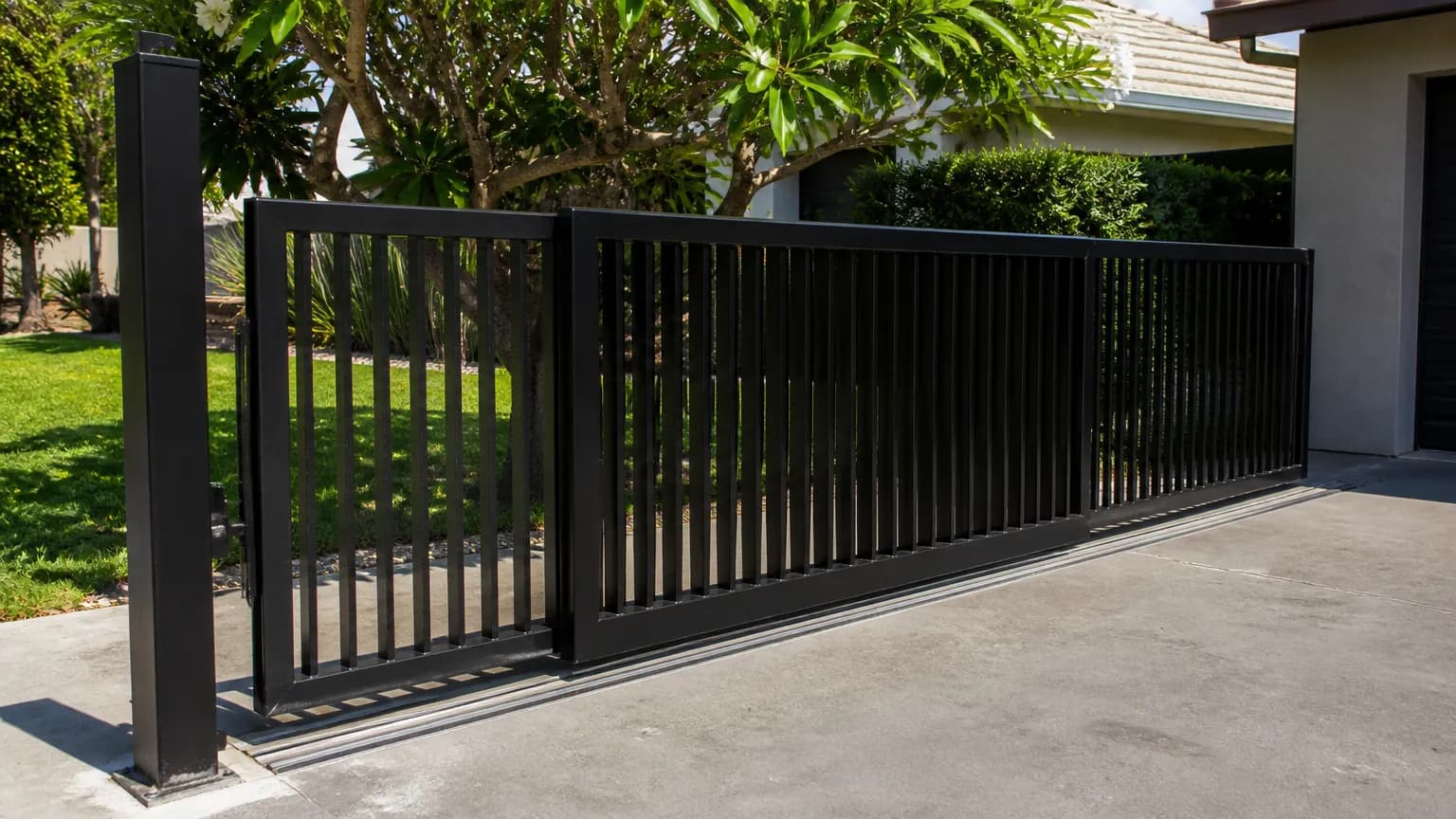
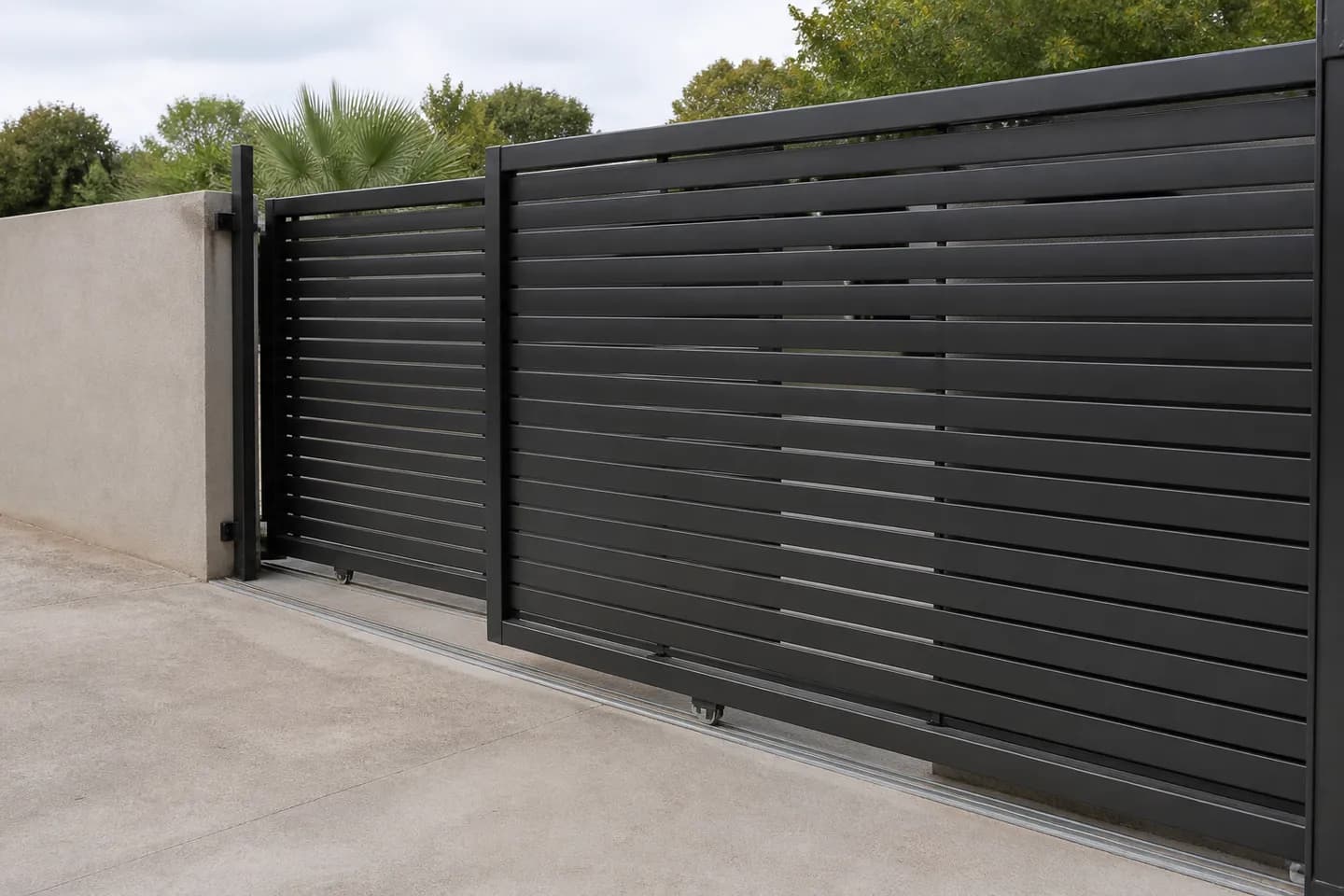
Each leaf runs on its own track, side by side. When the gate is shut, the leaves sit end to end across the opening. Each one overlaps the next a little, so there is no gap. CAD60 starts that overlap at 75 mm.
When the gate opens, the leaves slide the same way at different speeds. On a two-leaf gate the front leaf travels about twice as far as the back one, so they both arrive at the stack together. Commercial kits link the leaves with a cable and pulleys, and a motor drives the first leaf. The others follow.
The telescopic gate can be tracked or cantilever. Tracked is the common one, and the kind CAD60 draws. Cantilever kits exist too, though some makers limit them to two leaves.
How much room does a telescopic gate save?
Roughly, the gate parks in the width of one leaf. Here is a 6000 mm opening as an example, with 50 mm overlaps at the ends and 75 mm between leaves. The numbers move with your overlaps and tails, but the pattern does not.
| Gate type | Leaf width | Room beside the opening |
|---|---|---|
| Single tracked sliding gate | About 6.1 m | About 6.1 m, plus any motor tail |
| Single cantilever gate (50% tail) | About 6.1 m plus 3 m tail | About 9 m |
| Two-leaf telescopic | About 3.1 m each | About 3.1 m |
| Three-leaf telescopic | About 2.1 m each | About 2.1 m |
The catch is depth. Every leaf needs its own track, so a two-leaf gate is about twice as deep as a single gate where it parks. Check there is room behind the fence line as well as beside the opening.
When should you use a telescopic gate?
- A wide opening with short run-back. The classic case. The opening is wide and the room beside it is about half what a single gate needs.
- A wall or building cuts the slide short. When the gate cannot run its full length, splitting it is often the only way to fit a sliding gate.
- One leaf would be too long to handle. Two 3 m leaves are easier to weld, powder coat, carry and hang than one 6 m gate.
- Wide commercial entries. One Australian maker lists telescopic systems up to 9 m clear opening tracked and 10 m cantilever.
When is a single sliding gate the better pick?
Whenever the run-back is there. A single gate has one set of wheels, one track and nothing to keep in step. It is cheaper to build, quicker to hang and easier to service.
Measure before you assume. A lot of "we have no room" jobs have room for a tracked gate but not for a cantilever gate with its tail. The cantilever vs sliding gate guide shows how much room each one needs. Go telescopic when neither fits.
Is a telescopic gate the same as a bi-parting or bi-fold gate?
No. People mix these up all the time, so here is the plain difference:
- Telescopic: two or three leaves slide the same way and stack on one side of the opening.
- Bi-parting: two separate sliding gates open in opposite directions and meet in the middle. You need room on both sides.
- Bi-fold: hinged panels that fold up like a concertina. See bi-fold gate.
You can also combine them. Two telescopic gates opening in opposite directions cover a very wide opening with only a little room on each side. For the full range of gate types, see types of gates.
How do you size the leaves?
Start from the clear opening. Add the overlap at each end, then split it between the leaves, adding the overlap between each pair. On a two-leaf gate each leaf comes out a bit over half the opening. On three leaves, a bit over a third.
Then set the parts that only a telescopic gate has:
- The overlap between leaves, so the shut gate shows no daylight.
- The gap between the tracks, so the leaves pass without rubbing.
- The ground clearance, which has to fit the wheel and the track under every leaf.
Get the overlaps wrong and the gate either shows a gap when shut or jams when it opens. That is the part a drawing catches before you cut anything.
What are the downsides of a telescopic gate?
Cost and fuss. You build two or three frames instead of one, with a track and wheels under each. The leaves have to be linked so they move together, and that link needs setting up and checking. There are more parts to align on site and more parts to wear.
The ground matters more too. Every track has to be level and parallel. The sloped driveway guide shows how to check a site before you commit.
Common questions
When should you use a telescopic gate?
When the opening is wide but there is not enough room beside it for a single sliding gate to park. A two-leaf telescopic gate parks in about half the room.
How much room does a telescopic gate need?
About the width of one leaf beside the opening. For a 6 m opening that is roughly 3.1 m with two leaves or 2.1 m with three, plus enough depth for the tracks side by side.
How many leaves can a telescopic gate have?
Two or three is normal. CAD60 draws both. More leaves save more room but add a track, wheels and alignment work for each one.
Are telescopic gates more expensive?
Yes. You build more frames, fit more wheels and tracks, and link the leaves so they move together. Use one only when the space rules out a single gate.
Can a telescopic gate be automated?
Yes, and most are. A motor drives the first leaf and a cable and pulley system brings the other leaves along at the right speed.
What is a bi-parting sliding gate?
Two sliding gates that open in opposite directions and meet in the middle of the opening. It needs parking room on both sides, unlike a telescopic gate, which stacks on one side.
Written by Harry Tolley
Harry builds CAD60 with his dad, who has run a fabrication business for 20 years. We write these guides from what goes wrong in a real shop.