On this page
- What are the main types of gates?
- How wide can each type of gate go?
- How much room does each gate need to open?
- Should a driveway gate swing or slide?
- Is a cantilever gate better than a tracked sliding gate?
- Which gate type works on a sloping driveway?
- Which type of gate costs the most to build?
- How do you pick the right gate in five questions?
- Common questions
Most people pick a gate by how it looks. That is the wrong place to start. The site makes the big call for you: how wide the opening is, how much room sits in front of it, and how much fence runs beside it.
This guide walks through the seven common types of gates, what each one needs, and where each one goes wrong. Get the type right first. The infill, colour and latch come after.
What you need to know
- Pedestrian gates are for people. Everything wider is a driveway gate.
- Swing gates need a clear arc in front. Sliding gates need clear fence beside the opening.
- A cantilever gate keeps the driveway free of track but needs a tail about 40 to 50% of the opening.
- Telescopic and bi-fold gates are for tight sites where nothing simpler fits.
- Single swing is the cheapest to build. Telescopic is the dearest.
What are the main types of gates?
There are seven you will see on most jobs:
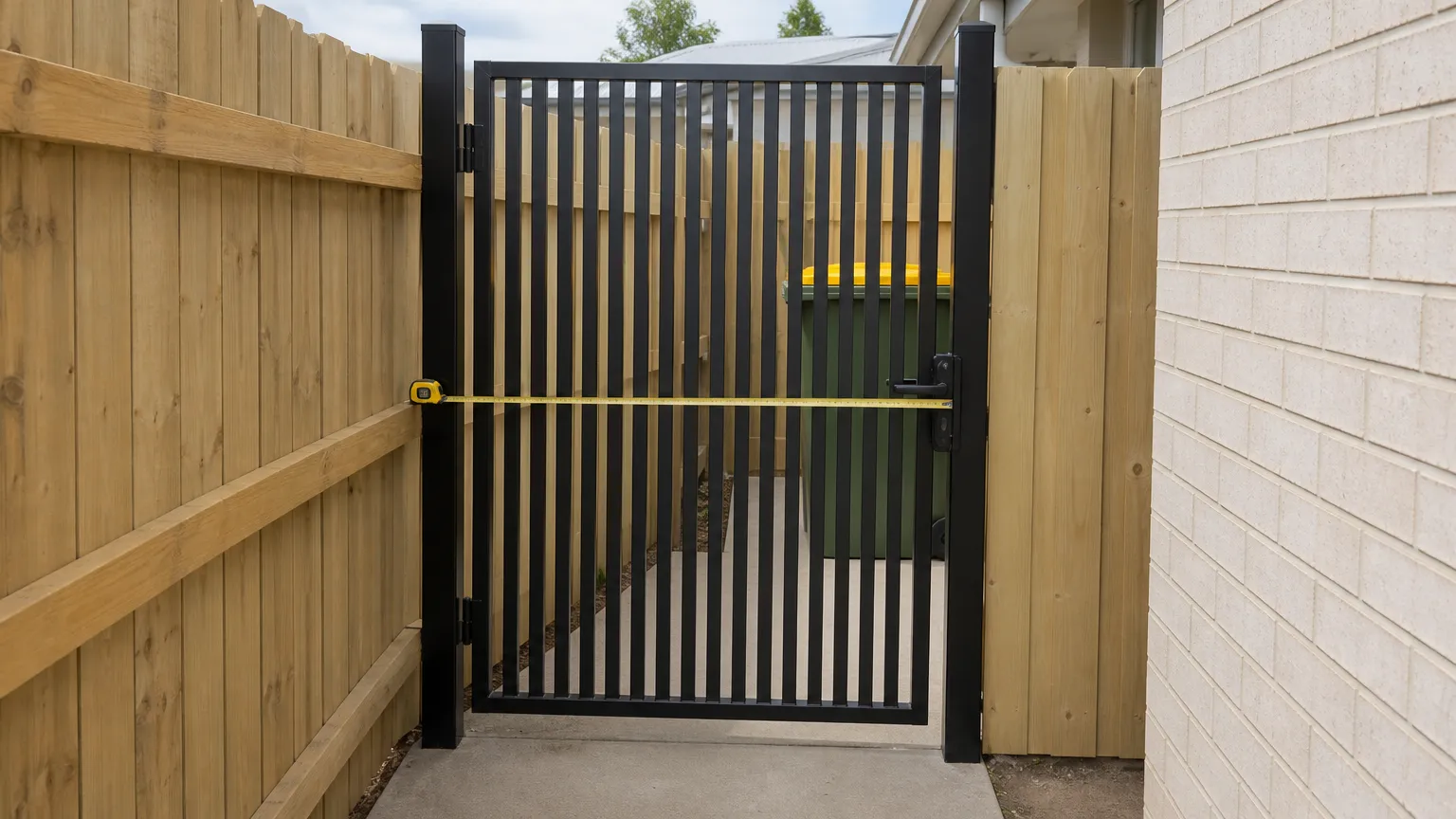
- Pedestrian gate. One leaf, sized for people. Usually 900 to 1100 mm wide. Front fences, side paths and the gate beside a driveway.
- Single swing gate. One wide leaf on one post. Simple and cheap, as long as the leaf is not too wide.
- Double swing gate. Two leaves that meet in the middle. Each leaf is half the width, so each post and hinge does half the work.
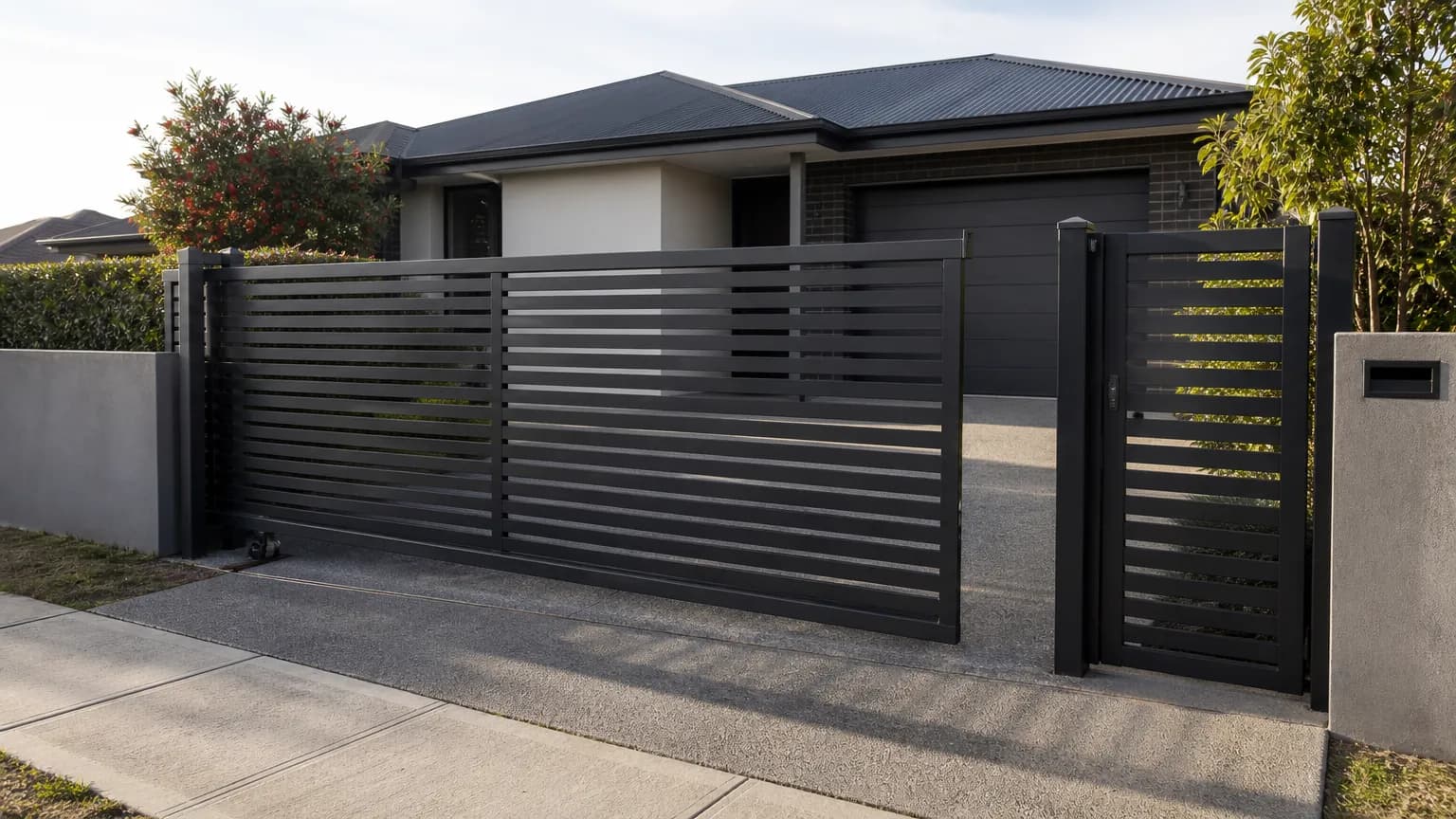
- Tracked sliding gate. The leaf rolls on wheels along a V-track set in the driveway.
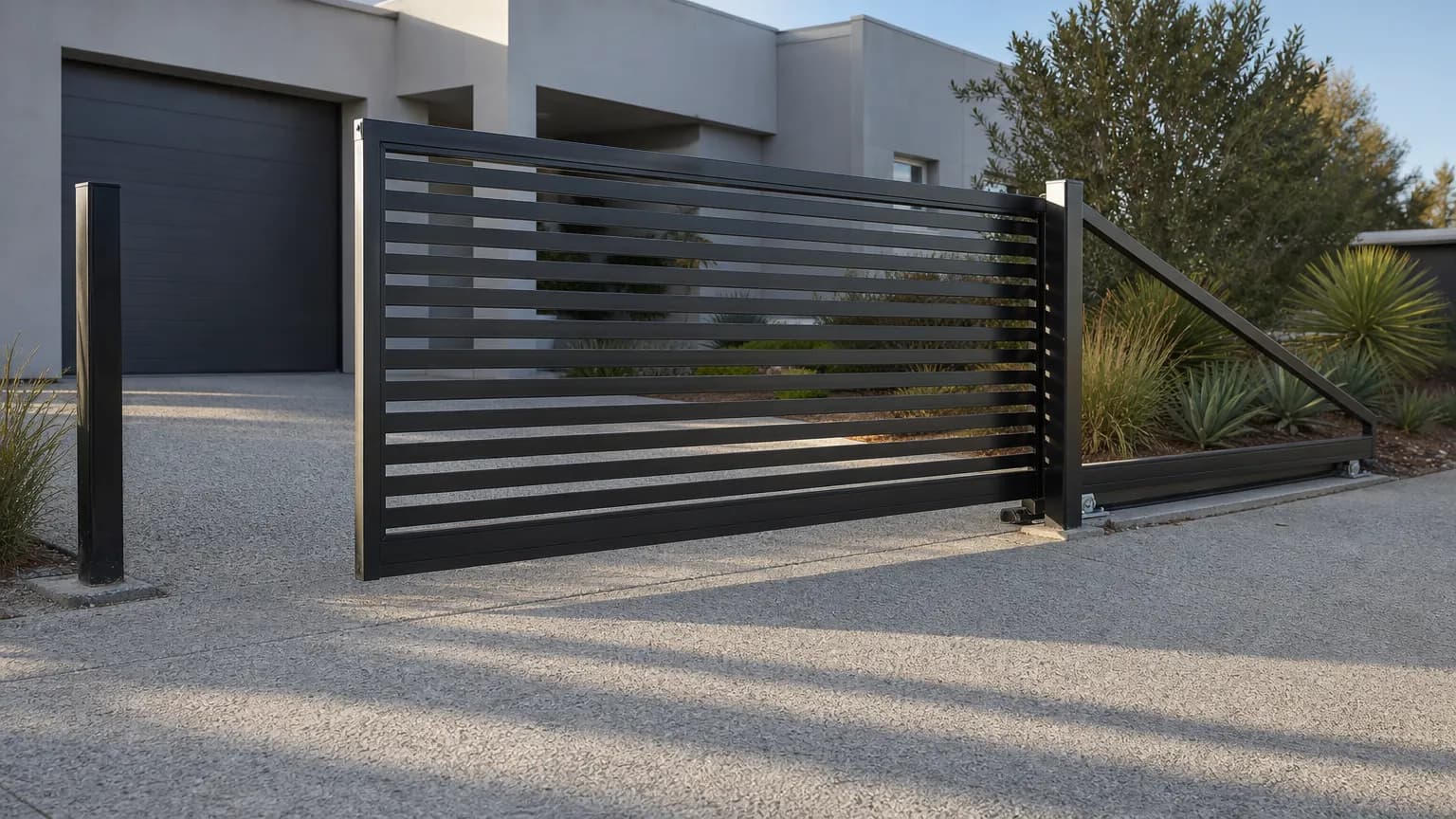
- Cantilever gate. A sliding gate with no ground track. It hangs from rollers on posts beside the opening, balanced by a tail.
- Telescopic gate. Two or more sliding leaves that stack behind each other, so they need less room to open.
- Bi-fold gate. Leaves that fold in half as they swing. Less arc than a double swing, more moving parts.
The first one is the easy call. If only people go through, build a pedestrian gate. Our guide to standard pedestrian gate sizes covers the widths and heights. The rest of this page is about the driveway types.
How wide can each type of gate go?
Every type has a width where it stops making sense. Past that point the posts, hinges or rollers get big and dear, and a different type does the job better.
| Type | Practical opening | Why it stops there |
|---|---|---|
| Pedestrian | 0.9 to 1.5 m | Wider than 1.5 m is really a small driveway leaf. |
| Single swing | Up to 3.5 m | The leaf works like a lever on the hinge post. Wider means a much bigger post and footing. |
| Double swing | 3 to 6 m | Two short leaves instead of one long one. |
| Tracked sliding | Up to about 8 m on a house, 12 m commercial | Track length is the opening plus the runout, so fence length is the real limit. |
| Cantilever | Up to about 12 m on a house, 20 m commercial | The tail adds 40 to 50% to the leaf length. |
| Telescopic | 3 to 12 m | Two leaves halve the runout. Three leaves cut it to a third. |
| Bi-fold | 3 to 6 m | Folding leaves get floppy and hard to automate when they get long. |
Width alone rarely settles it, though. A 4 m opening could be a single swing, a double swing or any of the sliders. Space is what narrows it down.
How much room does each gate need to open?
There are two kinds of room to check on site. Front clearance is the space a swing gate sweeps as it opens. Runout is the length of fence a sliding gate parks along.
- Single swing: a clear arc as deep as the leaf is wide, plus about 0.5 m. A 3 m leaf wants about 3.5 m of flat, clear ground behind the gate.
- Double swing: about half that. Two 1.5 m leaves need about 2 m of clear ground.
- Bi-fold: the folding cuts the arc roughly in half again. Handy when a parked car sits just inside the gate.
- Tracked sliding: runout of about 1.0 to 1.2 times the opening.
- Cantilever: the opening plus the tail. A 4 m opening needs about 5.6 to 6 m of clear fence line.
- Telescopic: the opening divided by the number of leaves, plus a little overlap.
Walk the site and measure both before you talk style. A sloping driveway, a tree, a meter box or a neighbour's fence can rule out half the list in one go.
Should a driveway gate swing or slide?
If the site has room for both, swing gates are cheaper to build and simpler to motorise. They have fewer moving parts and no track to keep clean. That is why single and double swings are still common on narrow suburban driveways.
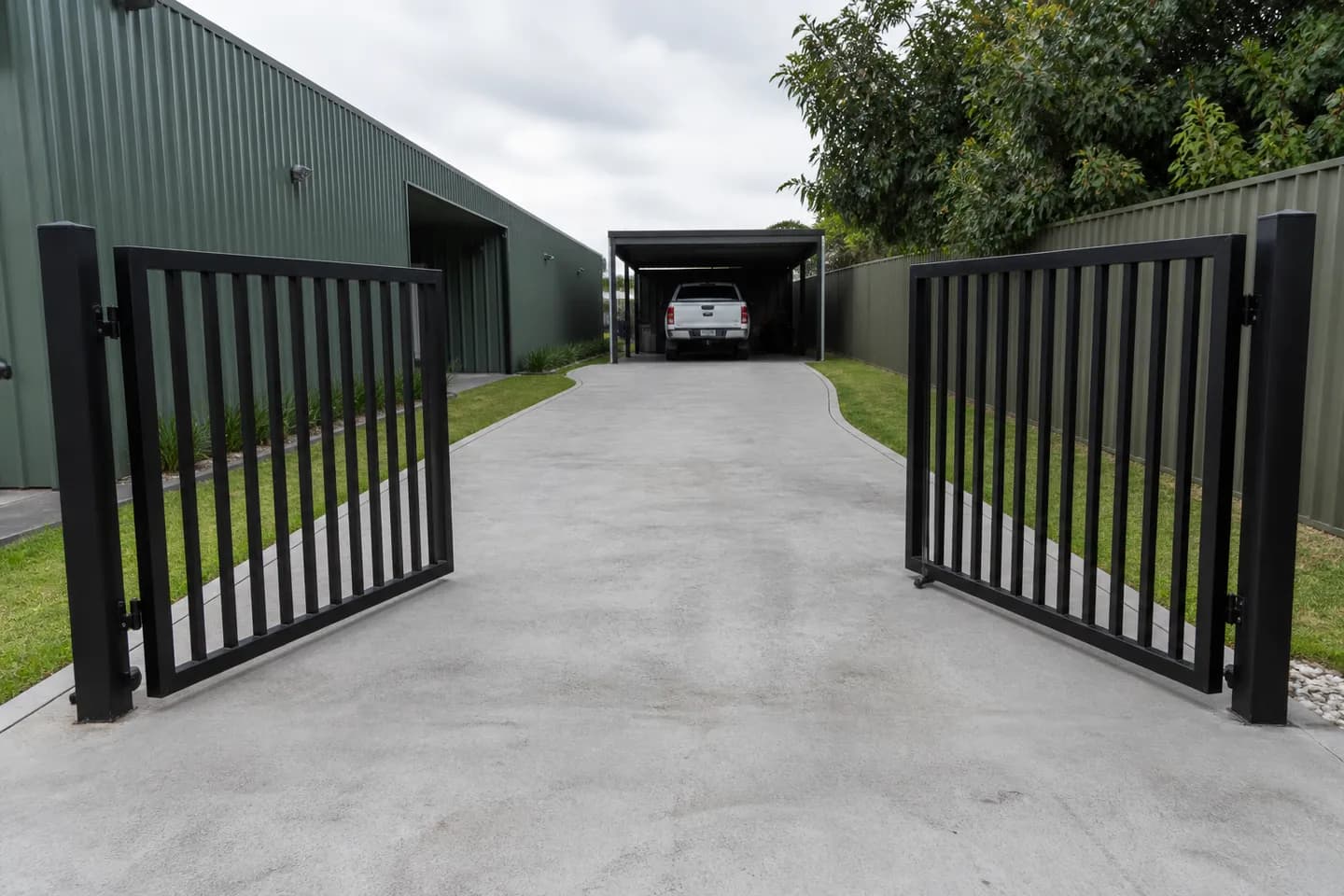
Sliding gates win when any of these is true:
- The driveway slopes up from the street, so a swing leaf would hit the ground.
- Cars park close inside the gate.
- The opening is wider than about 5 m.
- The gate opens onto a footpath, where it cannot swing out.
Sliding gates also look cleaner when shut and handle wind better, because the leaf runs along the fence line instead of catching the wind like a door.
Is a cantilever gate better than a tracked sliding gate?
It depends on the driveway. A tracked gate is cheaper to build because the leaf only needs to cover the opening plus a small overlap. The catch is the track. Leaves, gravel and water collect in it, and a V-track across a driveway can dam water if it crosses a drainage line.
A cantilever gate has no track at all. It hangs off roller carriages bolted to posts beside the opening, and a tail behind the rollers balances the leaf. Nothing touches the driveway, so there is nothing to clog. The price is a longer leaf, a longer runout and heavier posts.
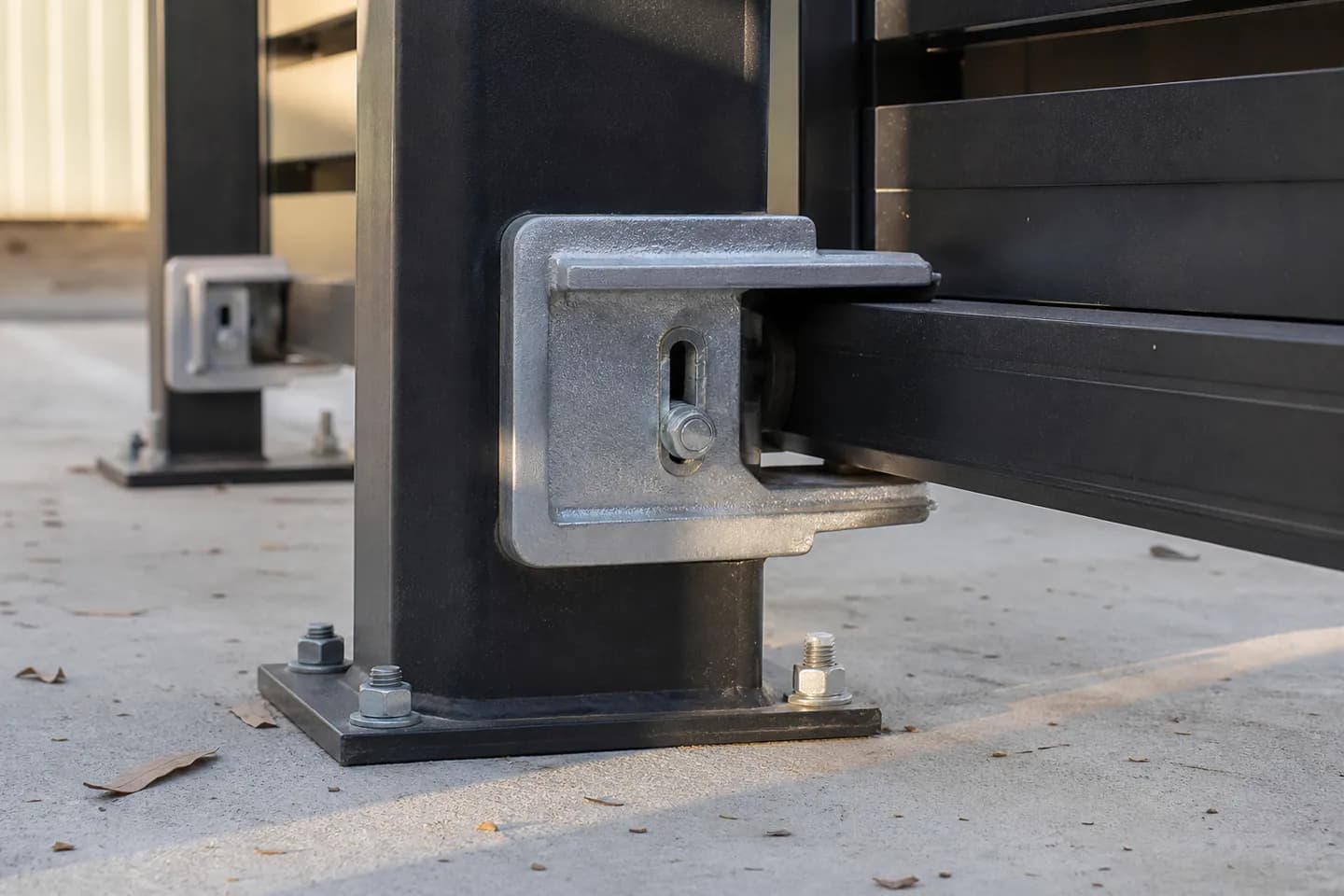
As a rule of thumb, plan a tail of about 40 to 50% of the opening. Our guides on cantilever vs sliding gates and cantilever gate tail length go into the detail.
Which gate type works on a sloping driveway?
On a slope across the opening, cantilever is the easiest slider. The rail stays level and only the bottom of the leaf follows the rake. A tracked gate is harder, because the track has to run straight and the wheels cannot climb.
Swing gates handle a slope across the opening well. They struggle with a slope that rises up the driveway, away from the street. The leaf hits the high ground before it opens fully. You can raise the leaf, fit rising hinges or step the bottom rail, but often a slider is the cleaner answer.
Measure a raked site carefully before you pick a type. The guide on measuring sliding gates on raked ground shows the datum line method.
Which type of gate costs the most to build?
For the same opening, the order is nearly always the same, from cheapest to dearest:
- Pedestrian gate
- Single swing
- Double swing
- Tracked sliding
- Cantilever
- Bi-fold
- Telescopic
A double swing has two sets of hinges, two posts and a drop bolt. A cantilever leaf is 40 to 50% longer than the opening and needs roller carriages. A telescopic gate has two or more leaves and the hardware to make them move together. Bi-fold and telescopic gates also take more time to set up on site.
A gate motor adds cost to any of them. Every type has off-the-shelf motor kits, but bi-folds are the fiddliest to automate well.
How do you pick the right gate in five questions?
Ask these in order. Stop at the first answer that fits.
- Is it only for people? Build a pedestrian gate.
- Is the opening under 3.5 m, with clear flat ground behind it as deep as the opening? Single swing.
- Is it 3 to 6 m, with clear ground about half that deep? Double swing.
- Is there fence beside the opening to slide along? Sliding gate. Pick cantilever if the driveway must stay free of track or it slopes. Pick tracked if it is flat, hard and clean.
- No arc and no runout? Telescopic. Or bi-fold, if a short swing arc is all you have.
Once the type is set, the next job is the frame and the posts. The guides on RHS vs SHS for gate frames and gate post size pick up from here.
Common questions
What is the most common type of driveway gate?
On wide suburban driveways, sliding gates are the most common. Below about 3 m, single and double swings are still everywhere. Cantilever gates are popular on new builds because owners do not want a track in the driveway.
Are sliding gates more secure than swing gates?
A little. A sliding gate has no hinges to attack and is hard to lift off when it has an anti-lift bracket. A swing gate needs a drop bolt so the leaves cannot be pried. The lock and the height of the gate matter more than the type.
Can you put a pedestrian gate inside a driveway gate?
Yes. A wicket gate is a small leaf built into one side of a driveway gate. It saves space. A separate pedestrian gate beside the driveway is simpler and more reliable, because each gate has its own posts and latch.
Do all types of gates work with a motor?
Yes. Swing gates use ram or arm openers. Sliding and cantilever gates use a rack and pinion drive. Telescopic gates use a drive with a cable or second rack to move the leaves together. Bi-folds need special hardware and are the trickiest.
Which type of gate needs the least maintenance?
A cantilever gate, in most cases. There is no ground track to clog and the rollers run on sealed bearings. A tracked gate needs its track swept. Swing gate hinges last for decades with a little grease once a year.
What is a bi-fold gate used for?
A bi-fold gate suits a wide opening with no fence to slide along and only a short swing arc inside, such as a carport with a parked car close behind the gate. It folds in half as it opens, so it sweeps about half the ground of a double swing.
Written by Harry Tolley
Harry builds CAD60 with his dad, who has run a fabrication business for 20 years. We write these guides from what goes wrong in a real shop.