On this page
- Can you weld galvanised steel?
- How far do you grind back the galvanising?
- What MIG settings work on galvanised steel?
- Are galvanised welding fumes dangerous?
- How do you repair galvanising after welding?
- Should you weld black steel and galvanise after?
- Where do vent and drain holes go for hot dip galvanising?
- Can you powder coat welded galvanised steel?
- Common questions
Most gate and fence shops weld galvanised tube every day. Pre-gal RHS for frames, hot dip posts on site, a hinge on an old gal gate. It welds fine once the zinc is out of the way. Leave the zinc on and you get spatter, holes in the weld, a lungful of fume and a joint that rusts first.
This guide covers how far to grind back, the MIG settings that work, the fume and how to deal with it, how to put the zinc back on, and when you are better off welding black steel and sending the whole job to the galvaniser.
What you need to know
- Grind the zinc off about 25 mm each side of the joint, both faces, before you weld.
- Zinc boils long before steel melts. The fume causes metal fume fever, so pull it away from your face.
- MIG with normal steel wire and mixed gas works. Go a little slower and expect more spatter.
- Put the zinc back with cold gal paint, two coats, 25 mm past the bare metal.
- For big frames, welding black steel and hot dip galvanising after gives the best coat, if you drill vent and drain holes.
Can you weld galvanised steel?
Yes. Under the zinc it is ordinary mild steel, and it welds like mild steel. The zinc is the problem. Zinc boils at about 907°C. Steel melts at about 1,500°C. So the arc boils the zinc off as white smoke before the steel even starts to melt.
That zinc vapour does four things you do not want:
- Porosity. Gas gets trapped in the weld as pinholes. You will see them on the surface, and there are more you cannot see.
- Spatter. Lots of it, stuck to everything.
- Weak welds. Zinc in the weld pool can cause cracking and lack of fusion. It looks welded and it is not.
- Fume. Zinc oxide fume makes you sick. More on that below.
Fix all four the same way: get the zinc off the joint first. See galvanised steel and pre-galvanised steel in the glossary for how each coat is made.
How far do you grind back the galvanising?
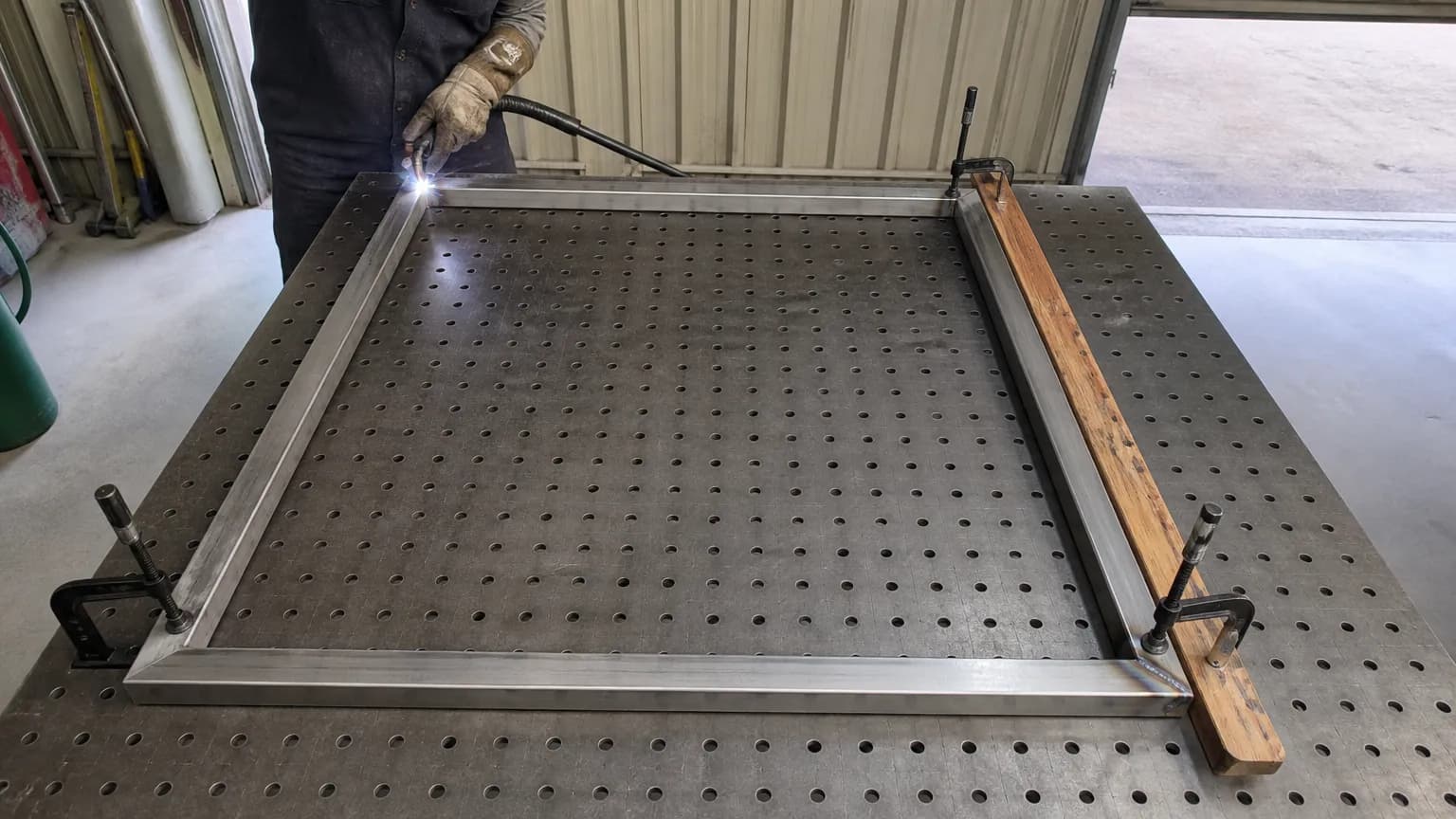
Grind the zinc off about 25 mm each side of the joint, on every face the weld will touch. On a T-joint that means the end of the rail and a band on the post where it lands. Go back to bright metal.
- Use a 40 or 60 grit flap disc. It takes the zinc off without eating the wall. On 1.6 mm tube, a hard grinding disc can take a millimetre off before you notice.
- Hit the back face and the edges too. Zinc on the far side of the joint still boils into the weld once the heat gets through.
- Cut the tube after grinding, or wipe the cut end. A drop saw leaves zinc dust on the face you are about to weld.
- You cannot grind the inside of a tube. Pre-gal tube with a coat inside will still give some fume and a few pinholes. That is normal. Keep the heat down and stitch it where you can.
What MIG settings work on galvanised steel?
Set up the same as for plain mild steel of the same thickness, then make a few small changes. Run a test on an offcut of the same tube first.
| Plain mild steel | Galvanised, ground back | |
|---|---|---|
| Wire | ER70S-6, 0.9 mm | Same. The silicon in S-6 helps with what zinc is left |
| Gas | Argon and CO2 mix | Same mix, flow up a little to cope with the fume |
| Travel speed | Normal | A bit slower, so zinc boils off ahead of the pool |
| Voltage | Set for the wall | A touch higher for a flatter, hotter puddle |
| Torch | Push or drag | Small side-to-side weave to keep the pool open |
| Spatter | Light | Heavy. Use anti-spatter on the nozzle and nearby faces |
Stick works well on gal and is the usual choice on site. 2.5 mm or 3.2 mm 6013 rods handle thin tube and painted or dirty steel better than most wires. Gasless flux core works too and makes even more smoke. TIG is a bad match: zinc fouls the tungsten in seconds, so you spend more time sharpening than welding.
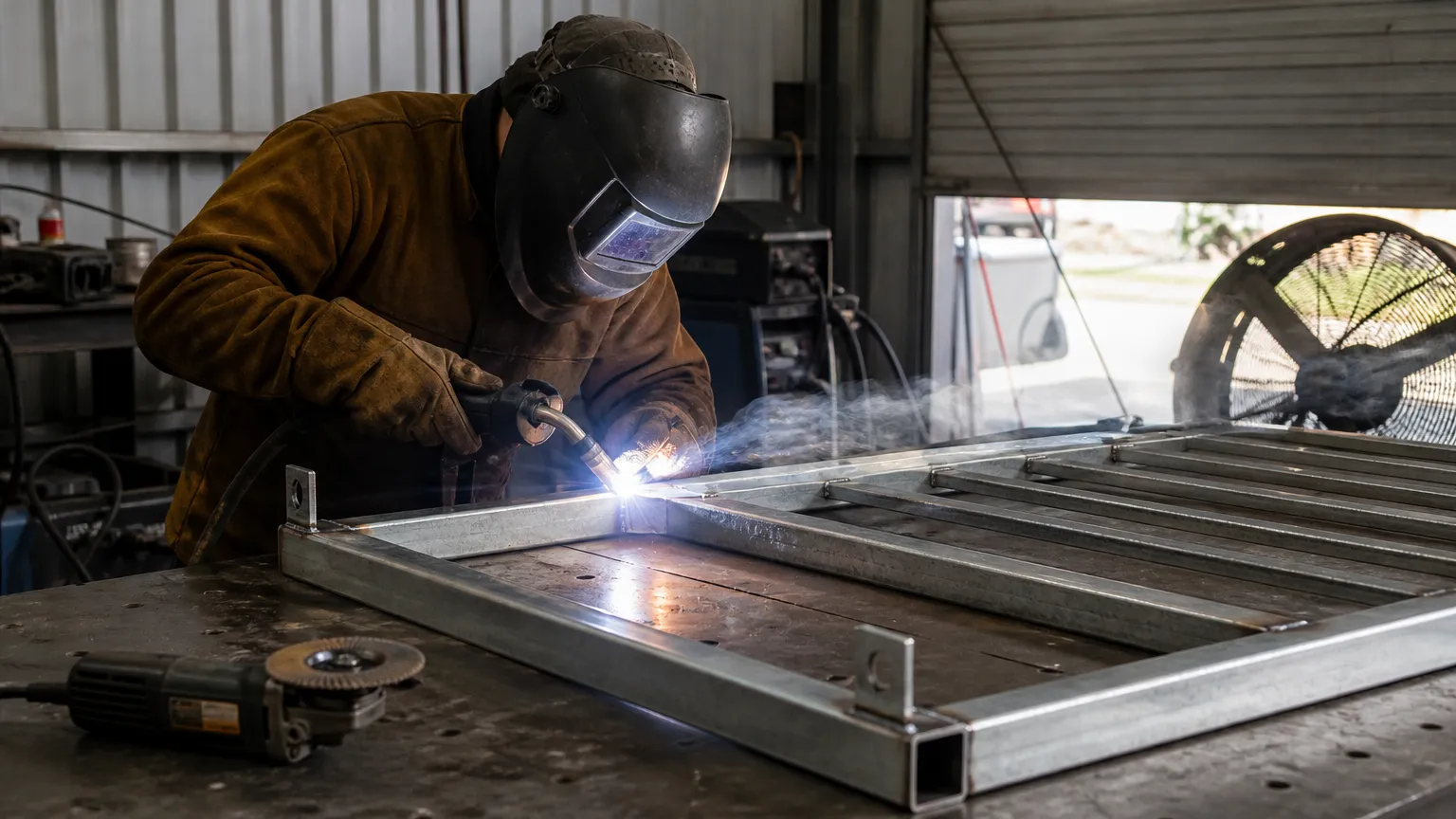
On thin pre-gal frames, tack all the corners first, then weld in short runs and swap between corners so the frame does not pull. Our guide on stopping a gate frame warping covers the order.
Are galvanised welding fumes dangerous?
Yes. Breathing zinc oxide fume causes metal fume fever. It feels like the flu: a metallic taste, a dry throat, chills, a fever, aches and a headache. It usually starts 4 to 12 hours after you breathe the fume, often that night, and passes in a day or two. Lots of welders have had it once. Getting it again and again is not something to shrug off.
How to keep the fume out of your lungs:
- Grind the zinc off first. Less zinc, less fume. This does more than anything else on this list.
- Pull the fume away at the arc. A fume extractor or a fan blowing across the job, not at you.
- Wear a respirator under the hood. A P2 mask rated for welding fume, or a powered air helmet if you weld gal a lot.
- Keep your head out of the plume. Weld from the side, not leaning over the joint.
- Work in the open where you can. A closed shed fills up fast.
Drinking milk before you weld gal is an old shop story. It does not stop metal fume fever. Moving the fume does. If you get chest pain or trouble breathing after welding, see a doctor.
How do you repair galvanising after welding?
The ground band and the weld are now bare steel, and they will rust first. Put zinc back on with a zinc-rich paint, often called cold gal. A spray can, like CRC Zinc It, suits small touch-ups. A brush-on tin gives a thicker coat for bigger areas.
Knock off the slag and spatter
Chip the slag, flick off spatter balls and wire brush the weld. Paint on top of spatter flakes off with the spatter.
Clean back to bright metal
A wire wheel or a flap disc over the weld and the ground band. No rust, no oil, no dust.
Wipe it down
Wipe with a solvent and let it flash off. Fingerprints are oil.
Two coats of cold gal
Cover the bare metal and run 25 mm onto the sound zinc around it. Let the first coat dry as the can says before the second.
Seal the tube ends
Cap any open tube and seal any hole you drilled. Pre-gal tube rusts from the inside out.
Cold gal is a repair, not a match for the real thing. It is thinner and softer than a hot dip coat. On a gate that lives by the sea, or will be painted, think about the next section.
Should you weld black steel and galvanise after?
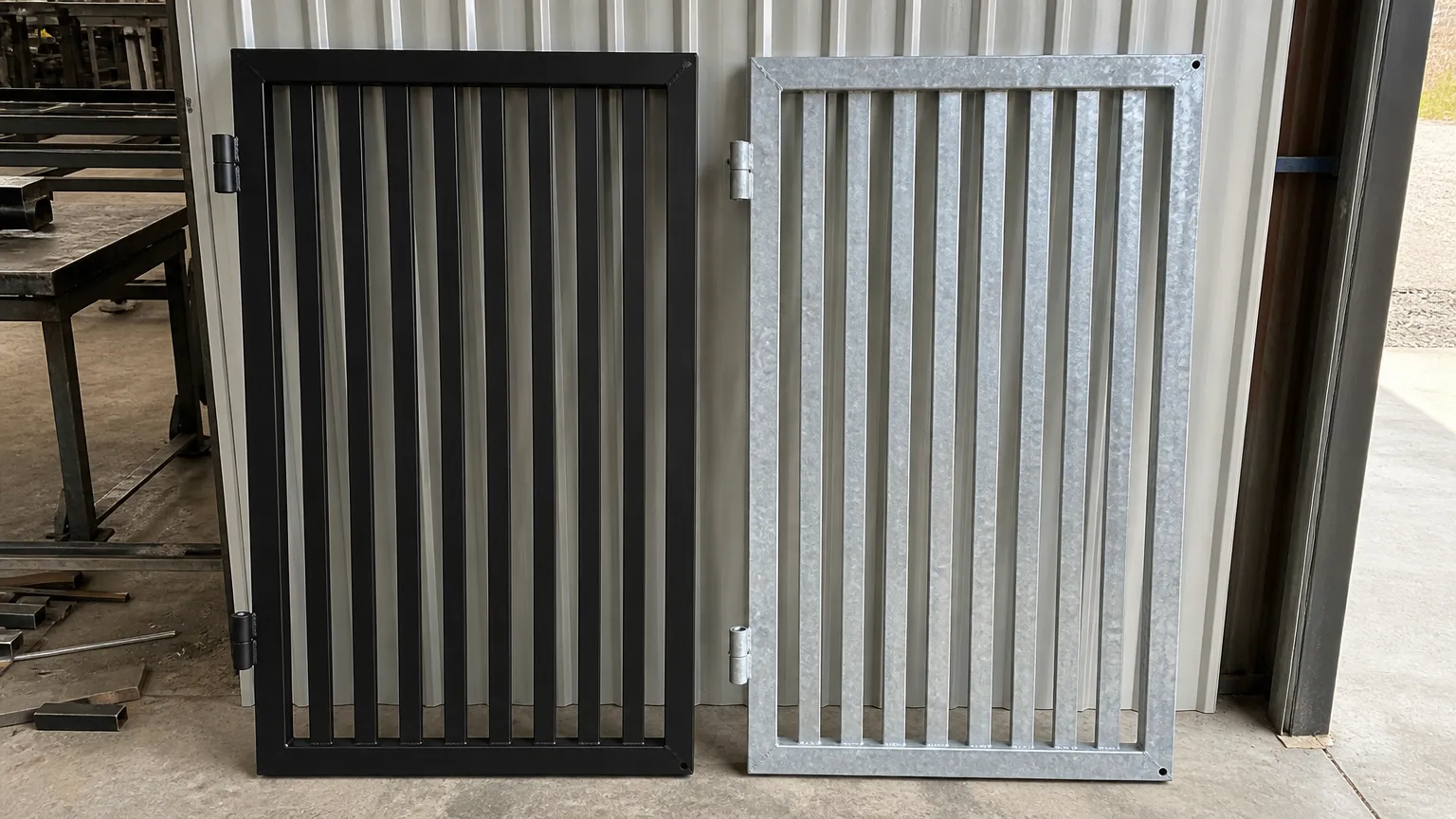
You have two ways to end up with a galvanised gate. Weld pre-gal tube and touch up the joints, or weld black (bare) steel and send the finished frame to a galvaniser to be hot dipped.
| Pre-gal tube, cold gal joints | Black steel, hot dip after | |
|---|---|---|
| Zinc on the outside | Thin mill coat, paint at the welds | Several times thicker, all over, welds included |
| Zinc on the inside | Thin or none, check the spec sheet | Full coat, if vent and drain holes let zinc in |
| Fume while welding | Yes | No zinc, no zinc fume |
| Turnaround | Weld, paint, done | Add a trip to the galvaniser, often a week |
| Distortion | Only from welding | The bath runs at about 450°C, so thin frames can move |
| Finish | Smooth, even, painted spots at joints | Rougher, can have drips and runs to file off |
| Best for | Light gates, fences, most home jobs | Heavy gates, coastal sites, farm and commercial work |
If you are sending it to be dipped, the steel has to be clean:
- Chip off all weld slag. The acid clean at the galvaniser does not remove it, and zinc will not stick to it.
- Use a water based anti-spatter. Silicone sprays leave bare patches.
- No paint, paint pen marks or stickers. They stay on through the clean and leave a bare spot. Mark with a scribe or chalk instead.
- Weld the frame balanced, corner by corner, so it holds its shape in the bath.
Where do vent and drain holes go for hot dip galvanising?
A hollow frame dipped in molten zinc needs a way for the zinc to get in, a way for the air to get out, and a way for the zinc to drain when it comes out. A sealed tube traps air, so the inside never gets coated. Worse, any water trapped in it turns to steam in the bath and can burst the tube. Galvanisers take that seriously and will send a sealed frame back.
- Every closed space gets two holes, one at each end, diagonally opposite, as close to the corner as you can drill.
- Where a rail butts into a stile, drill through the stile wall before you weld, so zinc flows from one tube to the next.
- Size: at least 10 mm, and bigger on bigger tube. Every galvaniser has a table for hole sizes. Ring yours and ask before you drill, not after.
- Posts: leave the caps off until after galvanising, or drill the cap and the base plate.
Put the holes on the faces that will face down, into the fence line or the back of the gate, where nobody looks at them. Then cap or plug the outside holes once the job is home, so water and wasps do not move in.
Can you powder coat welded galvanised steel?
Yes, and it lasts well. Galvanised and powder coated, often called a duplex finish, outlasts either one on its own. A few things make it go right:
- Tell the powder coater it is galvanised. They prepare it differently, usually with a light sweep blast or a chemical prep.
- Expect outgassing. Hot dip zinc can let off gas in the curing oven and leave pinholes in the powder. Coaters bake the job first to drive it out.
- Grind the welds smooth and knock off every spatter ball. Powder shows everything.
- Ask before you cold gal the welds. Some cold gal paints do not like the curing oven. Your coater will say which primer to use instead.
Building in aluminium instead? There is no zinc to worry about, but there is a whole new set of rules. See how to weld an aluminium gate and aluminium vs galvanised gates.
Common questions
Do you have to remove galvanising before welding?
You should. You can weld through it, but you get porosity, heavy spatter, weaker welds and a lot more zinc fume. Grind it off about 25 mm each side of the joint and the weld goes down like plain mild steel.
Can you weld galvanised steel to mild steel?
Yes. Grind the zinc off the galvanised side, weld it like two pieces of mild steel, then cold gal or paint the whole joint. The mild steel side needs protecting too or it will rust.
What wire do you use to MIG weld galvanised steel?
Normal ER70S-6 steel wire with an argon and CO2 mix works well. The extra silicon and manganese in S-6 help clean up the weld pool. 0.9 mm suits most gate tube.
How long does metal fume fever last?
It usually starts 4 to 12 hours after breathing zinc fume and clears up in one to two days. If you have chest pain or trouble breathing, or it keeps happening, see a doctor.
Does drinking milk stop metal fume fever?
No. It is an old shop story with nothing behind it. Grinding the zinc off, pulling the fume away with a fan or extractor and wearing a respirator are what stop it.
Can you TIG weld galvanised steel?
You can, but it is hard going. Zinc fouls the tungsten almost straight away, even after grinding. MIG or stick is the better tool for galvanised steel.
How big should vent holes be for galvanising?
At least 10 mm, and larger on bigger tube. Galvanisers each publish a hole size table, so ring yours before you drill. Put one hole at each end of every closed space, diagonally opposite.
More drawings for this job
Written by Harry Tolley
Harry builds CAD60 with his dad, who has run a fabrication business for 20 years. We write these guides from what goes wrong in a real shop.